
Axial - Observations #42
Life sciences reflections
Build with Axial: https://axial22.axialvc.com/
Axial partners with great founders and inventors. We invest in early-stage life sciences companies such as Appia Bio, Seranova Bio, Delix Therapeutics, Simcha Therapeutics, among others often when they are no more than an idea. We are fanatical about helping the rare inventor who is compelled to build their own enduring business. If you or someone you know has a great idea or company in life sciences, Axial would be excited to get to know you and possibly invest in your vision and company . We are excited to be in business with you - email us at info@axialvc.com
Observations #42
A set of ideas and observations from a week’s worth of work analyzing businesses and technologies.
Profiling infectious disease businesses
New medicines and vaccines for infectious diseases are always needed but the business of infectious disease has not been historically rewarded. Events like the COVID-19 pandemic reinforce the need for more sustainable businesses in the field - multidrug bacteria resistance, neglected tropical diseases (NTD), and communicable diseases in developing nations hopefully are given more attention and capital over the next few years.
However, building a new business to develop new antibiotics is not currently rewarded. Starting a business to prepare for pandemics was not highly valued until COVID-19 hit. Global public health is required to save more lives and a prerequisite for economic growth, but most companies do not currently have a global health mandate.
To explore the potential of building a large business in infectious disease, it is worth profiling a few case studies: Gilead, Moderna, Vir, Regeneron, AbCellera, Distributed Bio, Novavax, and BioNTech.
Gilead was founded in 1987 by Michael Riordan to cure viral diseases. Riordan had spent time in East Asia on a Luce scholarship after college. While abroad, he worked at a malnutrition clinic and came down with dengue fever. The exposure to another country’s healthcare system and experiencing the lack of medicine for viral disease inspired Riordan to go to medical school at Johns Hopkins and business school at Harvard to learn more about the business of medicine.
After working as a VC for a ~year, Riordan started Oligogen to use antisense DNA, an emerging technology in the 1980s, to selectively target viruses. The company’s name changed to Gilead after the Balm of Gilead, a medicinal product historically used in the Middle East. Riordan set Gilead on an ambitious path to cure viral disease and did everything to build a great team to accomplish this vision even persistently working to get Warren Buffett involved - https://www.scribd.com/doc/208120113/Michael-L-Riordan-the-Founder-and-CEO-of-Gilead-Sciences-and-Warren-E-Buffett-Berkshire-Hathaway-Chairman-Correspondence
The company was founded in the 1980s in the backdrop of the HIV epidemic. The same year Gilead was founded, 1987, AZT had just been approved by the FDA to treat AIDS patients. This created an urgency for Gilead and other infectious disease companies to develop new medicines for HIV/AIDS patients. Gilead’s timing was likely a major driver for its success - the need to develop new viral drugs was more acute than ever.
Early on, Gilead executed a deal with Glaxo for $8M to use their antisense technology in cancer. This enabled the company to have the capital to expand the purview of their platform: the most important part of this work was funding Antonin Holy’s lab. This led to Gilead’s first FDA-approved medicine in 1996 - Vistide for cytomegalovirus (CMV) retinitis in AIDS patients. Gilead continued to churn new approved drugs, like Truvada for HIV infection, mainly from the golden goose they had in the Holy Lab. This work helped make HIV/AIDS a manageable disease for most patients.
In 2011, Gilead acquired Pharmasset for ~$11B. This acquisition gave Gilead the rights to two approved medicines in Hepatitis C: Sovaldi and Harvoni, which ultimately cured the disease. Moreover, this event probably was the keystone moment for the significant growth of the biotechnology industry in terms of capital deployed and returned over the last decade. The size of the acquisition was one that hadn’t been seen since the early 2000s.
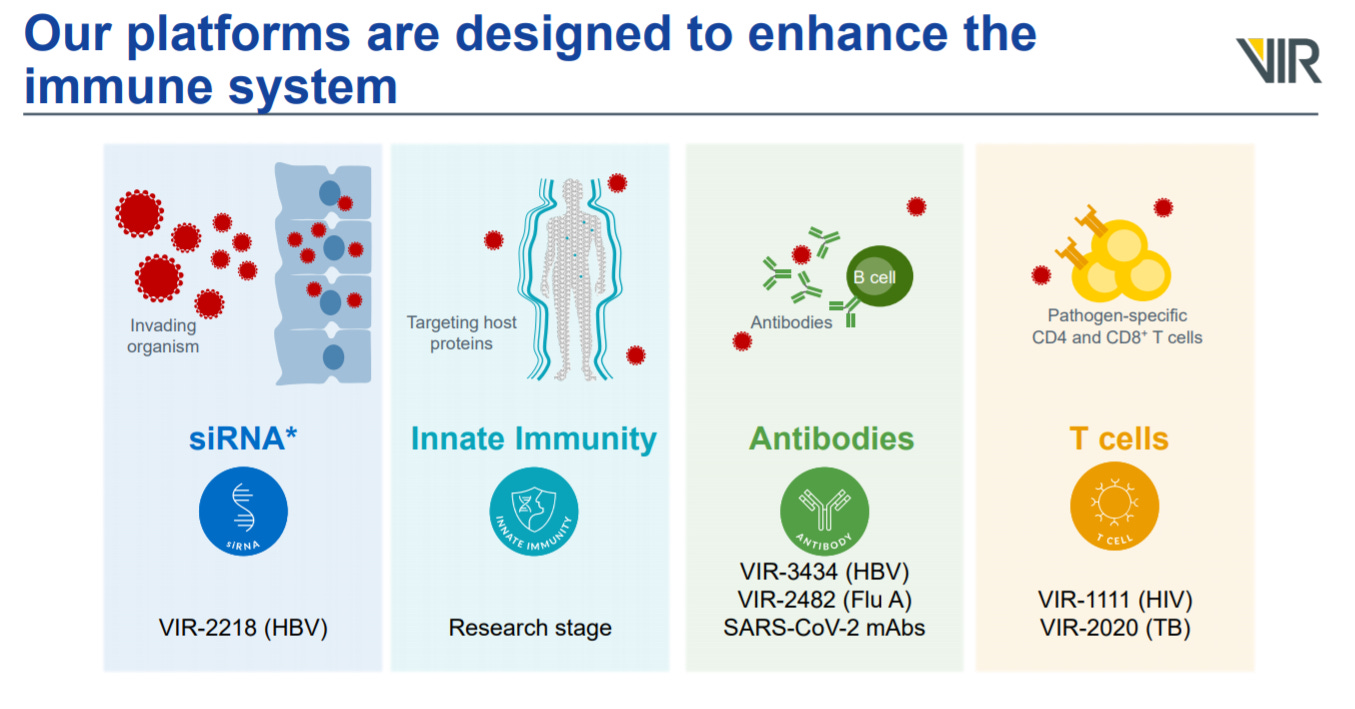
Another infectious disease company is Vir Biotechnology. Founded in 2016, Vir assembled an all star team to program the human immune system to fight infectious disease. The business model was very broad - developing multiple modalities from antibodies to siRNAs, and in-licensing assets, building an internal pipeline, and funding academic labs. The company is still relatively early especially when compared to Gilead. But Vir has played a role in the response to the COVID-19 pandemic. What makes Vir unique is its focus on the immune system rather than a particular pathogen.
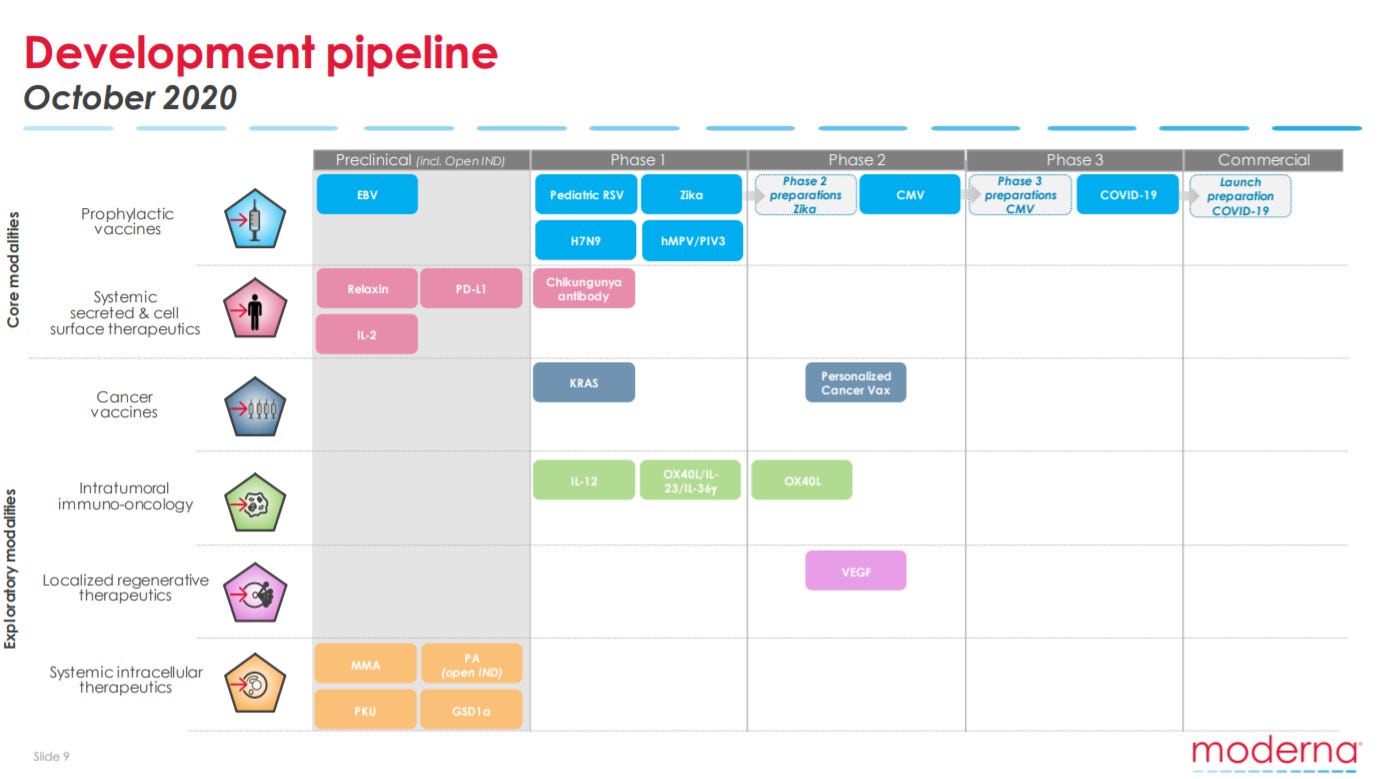
Moderna has played an essential role during this pandemic. Their recent vaccine authorization, along with BioNTech/Pfizer, is a major breakthrough for patients and society. It also validates their strategy to use mRNA drugs as a platform for infectious disease and beyond. The modality has had a lot of promise over the last 7-8 years, but COVID-19 accelerated what would have taken ~5 years to a few months. With the right timing and business model, Moderna is set up to bring mRNA medicines to a wider set of patients over the next few decades.
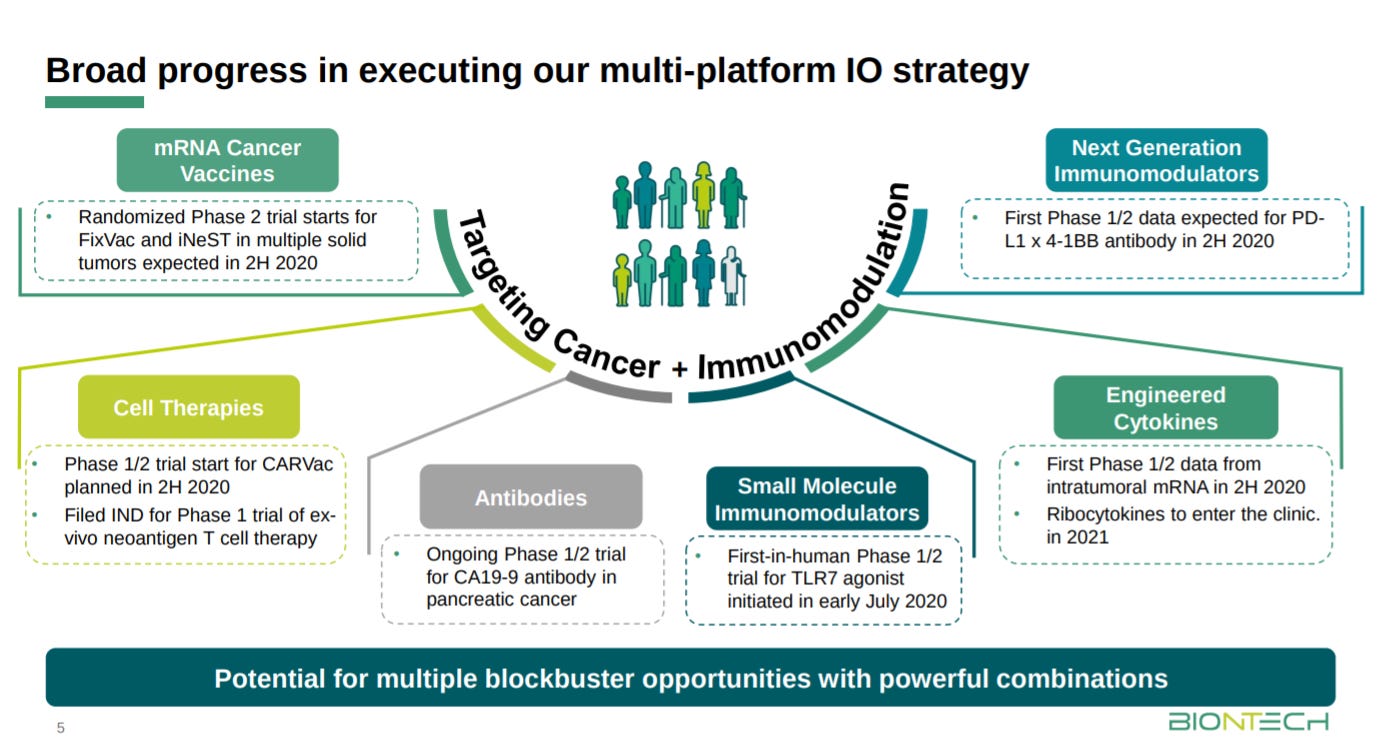
BioNTech is very similar to Moderna. With similar technology and positive COVID-19 vaccine data, BioNTech is also positioned to bring mRNA medicines to more patients. However, the company is also ingesting other modalities, similar to Vir, into its platform.
Novavax has been around for a long time. The company was founded in 1987 (same year as Gilead) to develop vaccines for infectious diseases. With no approved medicines over its lifespan, Novavax has relied on its platform and funding from foundations and public institutions (i.e. BARDA and Bill & Melinda Gates Foundation) to stay alive. The platform is centered around a set of recombinant nanoparticles and their Matrix-M adjuvant technology with the goal to generate strong patient immune responses to a vaccine. However, the Moderna/BioNTech vaccine data in COVID-19 might make this work somewhat irrelevant for this pandemic. But Novavax has vaccines in development respiratory syncytial virus (RSV), seasonal influenza, pandemic influenza (H1N1, H5N1), Ebola virus, among others. There might be an opportunity to update the COVID-19 vaccine every 2-3 years depending on the evolving strains.
Other businesses like Regeneron, AbCellera, and Distributed Bio are focused on developing monoclonal antibody platforms. They have more flexible business models where they license out assets in other disease areas and have the resources to invest in their underlying technology. This flexibility has enabled all 3 companies to rapidly respond to the COVID-19 pandemic. Regeneron has done the best job here with their antibody cocktail to treat patients.
Beyond drug development, curing infectious diseases requires a substantial role from public health. Everyone needs access to clean water and better nutrition. Maternal/reproductive health plays an important role. How do we increase accountability and prevent people from making decisions about other people’s health without consequences? Public health, things like vaccinations, trash pickup, sewage, and more, has a large impact on economic growth, lifespan, and wellbeing - https://oecdobserver.org/news/archivestory.php/aid/1241/Health_and_the_economy:_A_vital_relationship_.html:
“The effects of health on development are clear. Countries with weak health and education conditions find it harder to achieve sustained growth. Indeed, economic evidence confirms that a 10% improvement in life expectancy at birth is associated with a rise in economic growth of some 0.3–0.4 percentage points a year.
Disease hinders institutional performance too. Lower life expectancy discourages adult training and damages productivity. Similarly, the emergence of deadly communicable diseases has become an obstacle for the development of sectors like the tourism industry, on which so many countries rely.”
Can a sustainable and large infectious disease business be built without substantial government backing? Or is government backing a prerequisite? It sure seems so from the case studies. How can life sciences companies integrate with public health mandates? Can we set up a reward system to incentivize entrepreneurs and companies to eradicate diseases like malaria? Can we do the same for the deployment of rapid infectious disease diagnostics? What areas are just intractable and the realm of nonprofits? Can a universal vaccine be developed?
Key lessons:
Timing has been important. The HIV/AIDS epidemic helped kickstart Gilead and Novavax. The COVID-19 pandemic has done the same for BioNTech, Moderna, and Vir.
Platforms are essential to also work on other diseases like cardiovascular and cancer. This enables a company to raise capital to invest in technology and have the capabilities to work on infectious diseases. During more eras, capital has not been available to standalone infectious disease companies. Vir was an exception mainly due to the team.
There is an advantage to being centered around human immunology instead of pathogen focused. Moderna and BioNTech validate this with their COVID-19 vaccine. This enables a more rapid response and a broader scope.
There is an opportunity to connect drug development with a public health initiative. Beyond COVID-19, other opportunities are in NTDs and malaria.
Each case study, with the exception of Novavax, executed some form of the Merck model: focus on higher-value indications to subsidize programs with societal impact. In 1987, Merck freely distributed their medicine for river blindness. This was only possible because Merck had gotten Mevacor approved as the first statin the same year.
The open source playbook in life sciences
The open source community has really driven the growth of various software companies by providing layers of abstraction and more space to build new types of business models. In life sciences, IP is a moat but also a barrier for new company formation. What opportunities exist to open source life sciences?:
Inscripta - gene editing
OpenBiome and Finch Therapeutics - microbial transplants
Addgene - plasmids
Opentrons - benchtop liquid handling
Benchling - plasmid and CRISPR guide design
PostEra - computational medicinal chemistry
Synthace - device drivers
A straightforward opportunity is to aggregate the already open source software projects in genomics and beyond and productize them - https://awesomeopensource.com/projects/genomics If you are working on this or want to, please email us?
A journey of a kidney cancer patient during the COVID-19 pandemic
A really inspiring story of a patient with kidney cancer - https://www.mdanderson.org/cancerwise/my-kidney-cancer-treatment-before-and-during-the-coronavirus-covid-19-pandemic.h00-159381156.html?cmpid=twitter
At MD Anderson, once a patient completes their treatment program, they ring the bell -
Grad School Pressure