Axial - Observations #35
Life sciences reflections
Build with Axial: https://axial22.axialvc.com/
Axial partners with great founders and inventors. We invest in early-stage life sciences companies such as Appia Bio, Seranova Bio, Delix Therapeutics, Simcha Therapeutics, among others often when they are no more than an idea. We are fanatical about helping the rare inventor who is compelled to build their own enduring business. If you or someone you know has a great idea or company in life sciences, Axial would be excited to get to know you and possibly invest in your vision and company . We are excited to be in business with you - email us at info@axialvc.com
Observations #35
A set of ideas and observations from a week’s worth of work analyzing businesses and technologies.
The impact of securitization on drug development
Andrew Lo from MIT has done pioneering work over the last decade on the role of securitization in drug development. Research his group published ~8 years ago found, based on historical data of oncology drugs, that megafunds of drug candidates up to $30B can generate investment returns of ~9% for equity holders and ~5% for debt holders.
The premise of Lo’s framework is that the cost of drug development has steadily increased due to more biological complexity. This increasing cost is becoming more difficult to fund through traditional venture capital and equity financing. As a result, more sophisticated financing structures (i.e. the use of debt and securitization) are needed to bear this increasing cost. Whereas, new technologies are focused on wrangling the complexity, new financial tools are used to generate more shots on goal.
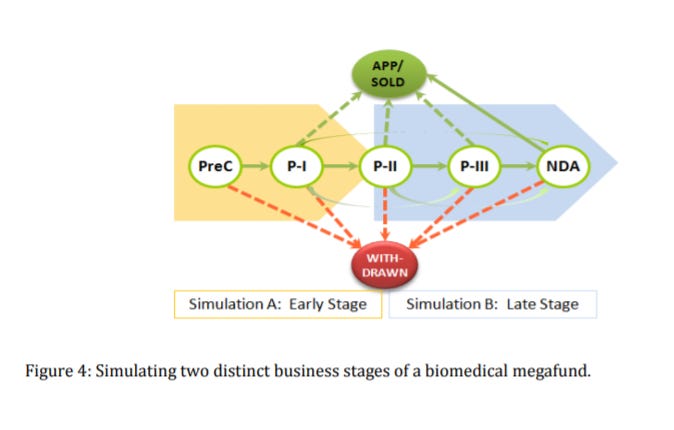
Lo proposes a megafund that pools capital from both equity and debt markets to fund drug development programs across different clinical stages. The main advantage of this type of entity is the ability to plug into the much larger debt market: $100Bs of equity versus $1Ts of debt issued per year. Some of the key features to the megafunds are:
The base case proposed is a $30B fund with 150 programs (some fail earlier than others). To make the fund profitable, one asset out of the 150 has to generate $2B of net income per year over a 10-year period after approval. So this implies a probability of approval success for the entire fund of 99.95% ((1-0.95)^150). The idea is that with more programs, the potential profits of the fund become more certain. In drug development, it might be easier to value a bag of lottery tickets than an individual one.
Beyond raising the capital, aggregating such a large amount of qualified programs is pretty hard
Another caveat is that most of these programs are probably not uncorrelated (similar MoA, biological risk overlap) so the power of diversification and odds of success are likely lower
To achieve the scale of capital, Lo proposes the use of securitization: issuing equity and bonds are different terms and seniorities where the assets and their corresponding cash flows are used as collateral. A key advantage here could be matching the duration of each security issued with the stage of the program (preclinical to going onto the market).
Companies like BridgeBio, Royalty Pharma, and others have pursued business models with some of these features. The large opportunity is for governments to do this type of work as a public good. Figuring out how to get the incentives right is a hard problem for public institutions. Due to the inherent difficulty of making a new medicine, financial engineering brings more capital to bear to at least try more potential solutions. Overall, different capital structures that can enable more trials might have a larger impact on medicine and patients than new technologies like machine learning. However, the company that can combine these two toolkits will likely generate a string of new medicines and become an iconic business.
Can Lo’s framework make an impact on other scientific fields and their commercialization? The concept of bundling high risk technical projects at scale to make cash flow more predictable as value in other fields like space and manufacturing. With the financial world willing to take longer duration risk, it is important for high risk/high impact companies to gain access to both debt and equity markets. This megafund idea only really works for ideas that can generate large/long-term payoff (i.e. $2B in annual profits). What other scientific fields have these features?
Functional genomics and medicine
As sequencing costs have super-exponentially decreased, the ability to profile genomes of tumors, immune cells among others provides the ability to connect the drug sensitivity of a cell to its genotype. This ability provides an opportunity to develop more precise medicines and inform treatment regimens. Companies like Foundation Medicine and Guardant Health have done incredible work here. What other opportunities are there to bring functional genomics to cancer, autoimmunity, and beyond?:
Building software and other tools to simplify treatment decision making. More patients are having at least panels of genes sequenced, but most of these biomarkers are not linked to a drug or any type of therapeutic decision.
Bringing the power of patient-derived organoids or cell-lines to directly test the potential effects of a drug. Using these functional assays is not just as easy as getting the sample but doing rigorous studies to ensure the positive rate is high enough for the cost.
Organoids are particularly useful for diseases without a known genetic driver. These tools are actually pretty useful to go from a response in a model to a potential target.
Ex vivo tools like organoids are unbiased and likely will face push back from the clinical community that likes to conduct tests with a hypothesis. However, the lowering costs of these tools and the analysis of the data generated will offer patients another pathway to medicine. Roche will probably buy an organoid company one of these days to match up with Foundation and Flatiron.
Single-cell sequencing tools like Perturb-seq have the potential to not only identify certain targets but match them to particular classes of cells
Also new trial designs like basket trials will require these types of tools to stratify patients and match multiple drugs in multiple disease types
The barrier for functional genomics to be useful for patients is showing clinical utility - can outcomes be above the standard of care?
What is Life?
What is Life? is one of the most important pieces of writing in life sciences. Guido Guidotti introduced me to this work when I was 18 and it transformed the way I look at the world. But more importantly, the book published in 1944 by Erwin Schrödinger influenced an entire generation of scientists to pioneer the field of molecular biology.
Chapter 1 (The Classical Physicist’s Approach to the Subject) focuses on how statistical physics is driven by the random motion of atoms and the tendency toward entropy. Whereas life is orderly. To reconcile this with life, Schrödinger suggests that life must have a highly durable hereditary molecule he calls an aperiodic crystal, which ultimately became DNA nine years later: “the most essential part of a living cell - the chromosome fibre - may suitably be called an aperiodic crystal.”
With this hypothesis, he describes how physicists' focus on periodic crystals at the time had led them to not make a large impact on biology. Whereas, organic chemists often deal with complicated molecules and as a result, had the toolkit to study aperiodic molecules and make a substantial impact on biology.
Schrödinger then poses the question: “Why should an organ like our brain, with the sensorial system attached to it, of necessity consist of an enormous number of atoms, in order that its physically changing state should be in close and intimate correspondence with a highly developed thought?”
He touches on two points to answer his own question:
For the physical brain to be connected to a thought, events within the brain must follow physical laws to a “ very high degree of accuracy”
Connected to the first point, interactions between physical bodies must also follow physical laws
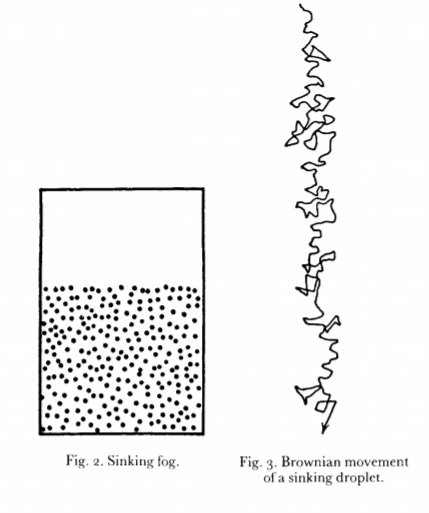
To tie together his points on how order is maintained by life, whether at the molecular or conscious level, Schrödinger provides a set of case studies. One he focuses on is Brownian Motion, which is the random motion of particles. A few molecules in a space will move disorderly; however, enough molecules will have some sort of order: sinking droplet versus sinking fog. To connect this with biology, an organism is so large relative to a single atom within it that the entropy of that atom has a very small effect. His points on order and entropy try to bridge the gap between looking at life as a thermodynamic system versus a mechanical one. Life must trend toward disorder because it follows physical laws, but life is also complex and can transfer information across generations and build large structures to resist this disorder.