Axial - Observations #24
Life sciences reflections
Build with Axial: https://axial22.axialvc.com/
Axial partners with great founders and inventors. We invest in early-stage life sciences companies such as Appia Bio, Seranova Bio, Delix Therapeutics, Simcha Therapeutics, among others often when they are no more than an idea. We are fanatical about helping the rare inventor who is compelled to build their own enduring business. If you or someone you know has a great idea or company in life sciences, Axial would be excited to get to know you and possibly invest in your vision and company . We are excited to be in business with you - email us at info@axialvc.com
Observations #24
A set of ideas and observations from a week’s worth of work analyzing businesses and technologies.
Alzheon and Alzheimer’s
Alzheimer’s, and neurodegeneration in general, is a very diverse disease. The last 15 years have seen a string of failures to improve the lives of Alzheimer’s patients. Two big drivers of this lack of success has been a myopic focus on beta amyloid as a target and lack of precision in clinical trial design.
Alzheon, a private startup, recently received a $47M grant from the NIH to execute a phase 3 trial for its small molecule prodrug that inhibits formation of amyloid oligomers. Briefly, the approach is not unique and has a high chance of failure given the priors; however the clinical trial trial is pretty unique:
GWAS studies along with others have shown a strong association of Apolipoprotein E (apoE) in Alzheimer’s (AD)
There are 3 polymorphic forms of apoE: 2, 3, 4 with patients carrying apoE4 as higher risk to develop AD and apoE2 having protective effects. The MoAs here are still being characterized with some data suggesting a dual role for all apoE isoforms.
Alzheon is working on a trial to test only patients who are homozygous for apoE4, about 10-15% of the AD population and ~2% of the overall population
The drug candidate showed safety and early signals of efficacy - https://alzheon.com/alzheon-publishes-new-analyses-from-phase-3-studies-showing-clinical-benefit-of-tramiprosate-in-alzheimers-patients-who-are-carriers-of-apoe4-the-major-genetic-risk-factor-in-up-to-65-percen/ The prodrug has been tested in ~2,000 patients in the general population not showing a significant effect.
It’s hard to predict whether this trial will work or not; however, it is a great signal of the improving precision of AD clinical trials. Tracking Alzheon’s trial will show have hard it is to recruit patients for specific genotypes. The trial Alzheon is setting off is incredibly hard - I wish them the best. This phase 3 study will enroll 300 patients who have two copies of apoE4 with plans to begin the study in Q1 2021. The trial will last for 18 months with the primary endpoint relying on the Alzheimer’s Disease Assessment Scale.
Decentralized clinical trials
With COVID-19 having a larger effect on the US than elsewhere and the specter of long-term clinical trial delays due to it growing (creating investment opportunities in the public market), remote and decentralized clinical trials need to be scaled. Several years ago, Pfizer attempted a remote clinical trial but failed to recruit enough patients. With companies like Science 37 among others receiving venture and biopharma backing, the core infrastructure is being built out to run decentralized clinical trials. What are the core pieces that need to come together to ensure that these trials can scale?:
Telemedicine (enabling follow ups)
Patient engagement and support (to ensure recruitment and measurements)
Home health management
Mobile device(s) tracking (to monitor and audit remote sites)
Supply chain logistics (between home and the lab)
Sample quality and delivery (i.e. quality control)
Sending physicians or nurses to homes
Bringing patients to visit trial sites safely from time-to-time
Beyond convenience, decentralized trials can enable truly global trials to recruit more diverse individuals and allow more trials to be initiated. However, from the Pfizer case study, customer service seems to be the most important part of successfully executing a decentralized clinical trial. Which companies are building out customer service tools to help patients, CROs, clinicians, and biopharma companies?
STING and innate immunity
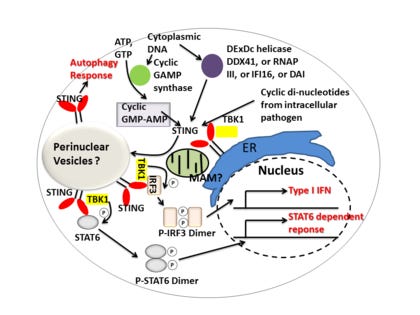
Stimulator of interferon genes (STING) is a protein that senses cytosolic DNA to activate T-cells and plays a major role in the human innate immune system. A strategy in immunotherapy is to develop new medicines that activate STING. However, the first-generation of STING agonists mimicked the natural analogs of STING called cGAMP (cyclic-GMP-AMP, a cyclic dinucleotide).
A pivotal moment in the STING field came in 2013 when the Chen Lab at the University of Texas Southwestern Medical Center discovered that an enzyme called cyclic GMP-AMP synthase (cGAS) binds DNA then produces cGAMP to activate STING - https://science.sciencemag.org/content/339/6121/786 This is a monumental paper in the innate immununity field. The hype began with billions of dollars of investments in developing cGAMP analogs to activate STING in the hopes of improving cancer treatments. However, cyclic dinucleotide are quickly broken down in the human body by phosphodiesterase enzymes. So the first generation of STING agonists required direct injection to the tumor site, a major limitation to convert these candidates into new medicines.
The next generation of STING agonists will need to be orally available or at least be given through an IV.
Excitedly and recently, two groups have identified two promising orally available STING agonists:
Scripps - https://science.sciencemag.org/content/369/6506/993 - small molecule agonist; showed tumor regression in a melanoma mouse model
Merck - https://science.sciencemag.org/content/369/6506/eaba6098 - STING agonist showing tumor regression as a monotherapy and with a anti-PD1 drug in colon cancer mouse models
This is just the beginning. The key issues with developing a STING agonists that is delivered in a pill is:
Ensuring stability of the molecule in the human body
Designing drugs to activate STING in specific tissues (maybe a prodrug) because broad activation of STING could have major toxicity issues
Target identification in drug development
Genomics commodified target discovery. A recent discussion I had on Twitter -

- reinforced that it's a great thing for patients that finding new targets for a given disease is no longer a sole competitive advantage. Millennium Pharmaceuticals was the iconic company for discovering new targets and selling them in bulk to partners like Bayer and BMS. However, Millennium ultimately had to develop their own products via an acquisition to truly become a large business.
There is an entire new generation of companies relying on machine learning or other new technologies to argue that a large and enduring business can be built with a target discovery platform. Similarly, many of the winners in this current batch will need to take a piece out of Millennium’s playbook and develop their own internal medicines or acquire them. 23andMe is already on that track. Others will likely follow suit. Overall, that fact that cheaper sequencing commodified target discovery has forced companies to compete on their development processes and medicines. This is a very important point: great tools companies like Illumina and 10X Genomics increase access to cutting-edge methods to everyone so they can compete on their actual products. What part of drug development is next? Medchem? Humanized mice? What else?
Immunometabolism and cancer
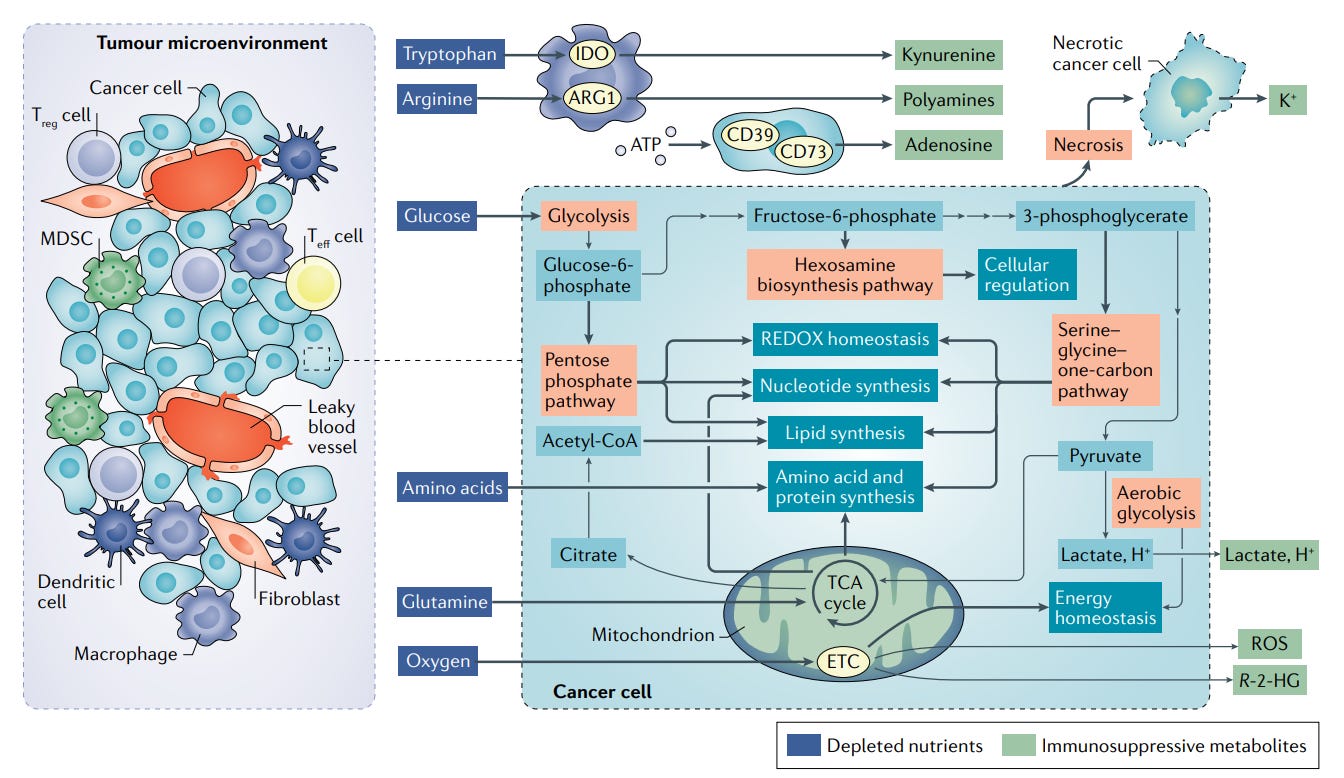
Metabolism creates a set of diverse tumor microenvironments (TME) across cancers and patients. Importantly, metabolism within each TME has a significant effect on immune cell function and the ability for immunotherapies and cell therapies to treat solid tumors. Particularly, immune and cancer cells actually converge on their metabolic pathways competing for the same resources to grow. This creates an environment to inhibit immune cells in the TME but also an opportunity to target metabolism to help immune cells and target cancer cells.
Companies like Agios (targeting IDO) have been built on the premise of targeting metabolism to treat cancer. However, the full potential of the field is still to be realized mainly due to the diversity of immune cells in the TME and the unique role of oxidative phosphorylation and glycolysis along with other pathways in immunometabolism. Companies like Rheos -
https://rheosrx.com/
and Sityx -
http://www.sitryx.com/
are sprup up to take advantage of this opportunity with each companies getting their own deal respectively:
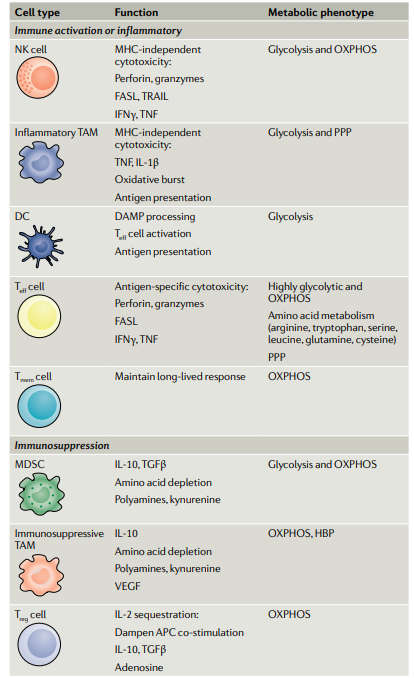
Immunometabolism is such a complex field. Immunology is already hard enough. Adding metabolism on top of it only makes figuring out cause/effect relationships even more difficult. Which labs or companies are pursuing methods to link immunometabolism with a specific cancer or any inflammatory disease like T1D for that matter?:
Measuring the metabolism difference between a given tumor and immune cells in the TME
Metabolic requirements for each immune cell effector
Use this information to find weak spots in metabolism to pursue and develop new medicines. The hard part here is the differences might be so slight that therapeutic windows could be very narrow.