
Veeva
Surveying great inventors and businesses
Axial: https://linktr.ee/axialxyz
Axial partners with great founders and inventors. We invest in early-stage life sciences companies such as Appia Bio, Seranova Bio, Delix Therapeutics, Simcha Therapeutics, among others often when they are no more than an idea. We are fanatical about helping the rare inventor who is compelled to build their own enduring business. If you or someone you know has a great idea or company in life sciences, Axial would be excited to get to know you and possibly invest in your vision and company . We are excited to be in business with you - email us at info@axialvc.com
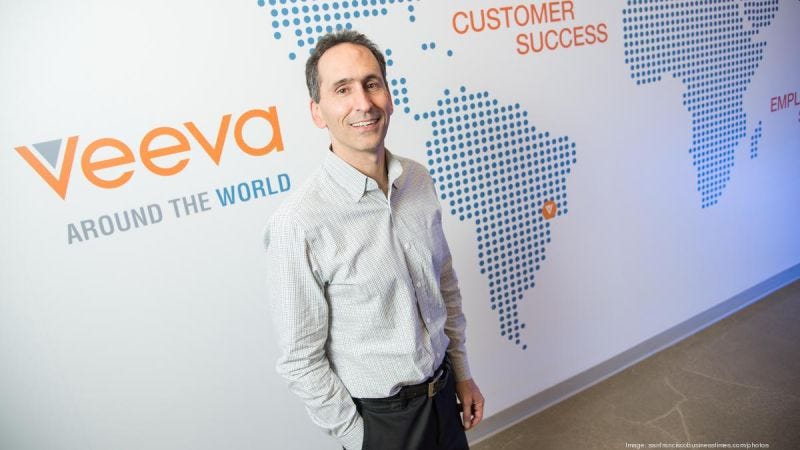
Veeva Systems was founded in 2007 by Peter Gassner and Matt Wallach to make life sciences more efficient and bring new medicines to patients. The company is one of the most important case studies on how to build a standalone software business in life sciences. Focused on managing clinical data and communications for life sciences companies, Veeva pioneered the vertical Software-as-a-Service (SaaS) business model by building out one of the first industry-specific clouds.
With Veeva, Peter was focused on building a lasting company, and a lasting company “needs a good profit margin.” So he set running a profitable business as an immutable parameter and built around it. Veeva raised $7M in venture capital, only using $3M of it, before going public. This scarcity of capital focused the company across sales, deal making, and team building. Early on in Veeva’s lifespan, Peter only set quarterly goals for the first few years then graduated to annual then 5-year goals as the company grew. Throughout this adventure, Peter was pressured to spend more but he took a conservative approach to minimize dilution and keep Veeva focused. This is represented in their values that has driven their decision making since founding:
1. Be frugal with capital and selective with who is hired
2. Get the product out quick
3. Sell product at a good price to as big of a customer as possible
4. Don’t give away professional services (often services are not profitable for most SaaS companies). For Peter, a product comes with a certain amount of services like customer support, training, among others.
These values drove long-term growth for the company:
1. Veeva has built the leading end-to-end software product in life sciences with the potential to build out pretty strong multi-side network effects.
2. An important part of Veeva’s success was its sales strategy. Veeva used a reverse churn strategy to expand their addressable market. With hundreds of customers, the company had to figure out a way to upsell them without deteriorating their brand. The first step to have a shot at reverse churn is getting lock-in. Veeva does this with integrations, data, and services to increase switching costs for the customer.
3. Software companies in life sciences will meet at a Milvian Bridge as their product offerings increasingly overlap. Veeva shows that software in highly regulated industries requires different growth strategies. The company used the Salesforce CRM platform and prior relationships to execute a brilliant top-down strategy. There are now develop-driven strategies and increasingly fintech ones to get users. And as the physical world of the lab converges with software, simulated environments may increasingly become a standard. As a result, interoperability, software persistence, and scale across life sciences and healthcare becomes much more important in this scenario.