
Snakemake
Surveying great inventors and businesses
Axial: https://linktr.ee/axialxyz
Axial partners with great founders and inventors. We invest in early-stage life sciences companies such as Appia Bio, Seranova Bio, Delix Therapeutics, Simcha Therapeutics, among others often when they are no more than an idea. We are fanatical about helping the rare inventor who is compelled to build their own enduring business. If you or someone you know has a great idea or company in life sciences, Axial would be excited to get to know you and possibly invest in your vision and company. We are excited to be in business with you — email us at info@axialvc.com

Snakemake is a workflow management system that used in bioinformatics and computational biology. It was developed by Johannes Köster and introduced in a 2012 Bioinformatics paper. Snakemake allows researchers to define complex, scalable data analysis workflows using a Python-based language. Workflows are specified through a Snakefile that defines rules for how to create output files from input files. And automatically determines the dependency graph and parallelization of jobs based on the input/output file patterns specified in the rules. This saves researchers from having to explicitly specify dependencies.
A major strength is its flexibility - Snakemake can interface with any software tool or code as long as it has well-defined inputs and outputs. This allows easy integration into existing analysis pipelines. Snakemake supports wildcards in input/output filenames, including multiple named wildcards, which provides a concise way to write rules that apply over many files following a pattern. Workflows defined in a Snakefile are inherently portable and can scale across different computational environments from single workstations to cluster systems without modification.
Snakemake provides useful features like automatically removing incomplete job outputs, visualizing the workflow dependency graph, and seamlessly restarting failed workflow runs. It is designed from the ground up for scalability and parallel execution across CPU cores and cluster nodes while respecting resource constraints.
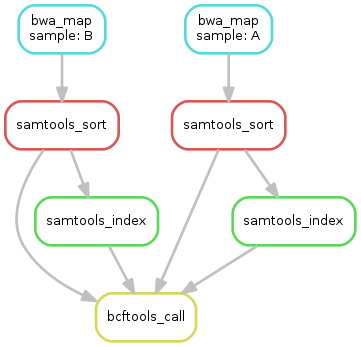
In the rapidly evolving field of bioinformatics and computational biology, where data analysis pipelines are becoming increasingly complex, the need for efficient and scalable workflow management systems has become paramount. Snakemake, a Python-based workflow management system, has emerged as a powerful and flexible solution.
At its core, Snakemake allows researchers to define complex, scalable data analysis workflows using a Python-based language. The workflows are specified through a Snakefile, which defines a set of rules that dictate how to create output files from input files. This approach is a significant departure from traditional workflow management systems, where researchers often had to manually specify dependencies and parallelization strategies.
One of the key strengths of Snakemake lies in its ability to automatically determine the dependency graph and parallelization of jobs based on the input/output file patterns specified in the rules. This feature saves researchers from the tedious task of explicitly specifying dependencies, which can be error-prone and time-consuming, especially in large-scale projects. By letting Snakemake handle the dependency resolution and job scheduling, researchers can focus their efforts on the scientific aspects of their work, rather than getting bogged down in the intricacies of workflow management.
Snakemake's flexibility is another standout feature that has contributed to its widespread adoption. Unlike many workflow management systems that are designed for specific domains or tools, Snakemake can interface with any software tool or code as long as it has well-defined inputs and outputs. This flexibility allows researchers to seamlessly integrate Snakemake into their existing analysis pipelines, leveraging the power of Snakemake's workflow management capabilities without having to overhaul their established toolsets.
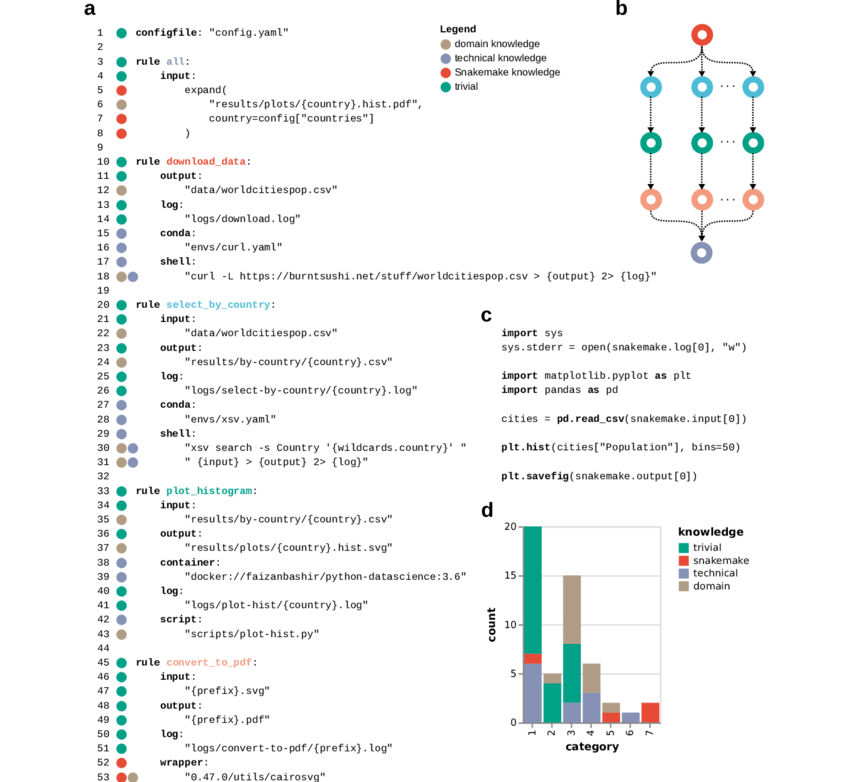
Portability and scalability are two critical factors in modern data-intensive research, and Snakemake excels in both areas. Workflows defined in a Snakefile are inherently portable and can scale across different computational environments, from single workstations to cluster systems, without requiring modifications. This feature is particularly valuable in collaborative research projects, where scientists may need to share and reproduce workflows across different computational platforms.
In addition to its core workflow management capabilities, Snakemake provides a suite of useful features that enhance the overall user experience and productivity. For example, Snakemake automatically removes incomplete job outputs, ensuring that only fully completed results are retained. This feature helps maintain data integrity and prevents downstream analyses from being corrupted by partial or incomplete results.
Another useful feature is Snakemake's ability to visualize the workflow dependency graph. By providing a graphical representation of the workflow, researchers can gain valuable insights into the structure and dependencies of their analysis pipelines, which can aid in debugging, optimization, and communication with collaborators.
Snakemake also offers seamless restarting of failed workflow runs, allowing researchers to pick up where they left off without having to rerun the entire pipeline from scratch. This feature can save significant time and computational resources, particularly in long-running and resource-intensive analyses.
To illustrate the power and conciseness of Snakemake, consider the example provided in the documentation for performing sequence read mapping, a common task in bioinformatics. The Snakefile encodes a multi-step pipeline involving quality control, read trimming, alignment, and sorting, all in a few lines of code:
```
rule all:
input:
"mapped-reads.bam"
rule map_reads:
input:
"trimmed-reads.fastq"
output:
"mapped-reads.bam"
shell:
"bwa mem -R '@RG\\tID:sample\\tSM:sample' genome.fa {input} | samtools view -Sb - > {output}"
rule trim_reads:
input:
"raw-reads.fastq"
output:
"trimmed-reads.fastq"
shell:
"trim_galore {input} -o ./"
```
This concise Snakefile demonstrates how Snakemake can elegantly capture complex bioinformatics pipelines, leveraging the full power of the Python language while maintaining readability and maintainability. The use of wildcards and automatic dependency resolution further enhances the expressiveness and scalability of the workflow.
Beyond its technical merits, Snakemake has also contributed to improving the reproducibility of data-intensive research. By providing a standardized and well-documented way to define and execute computational workflows, Snakemake facilitates the sharing and replication of analyses among researchers, fostering collaboration and transparency in the scientific community.
