
Profiles in Biotech (9/5/23)
Analysis
Axial: https://linktr.ee/axialxyz
Axial partners with great founders and inventors. We invest in early-stage life sciences companies such as Appia Bio, Seranova Bio, Delix Therapeutics, Simcha Therapeutics, among others often when they are no more than an idea. We are fanatical about helping the rare inventor who is compelled to build their own enduring business. If you or someone you know has a great idea or company in life sciences, Axial would be excited to get to know you and possibly invest in your vision and company . We are excited to be in business with you — email us at info@axialvc.com

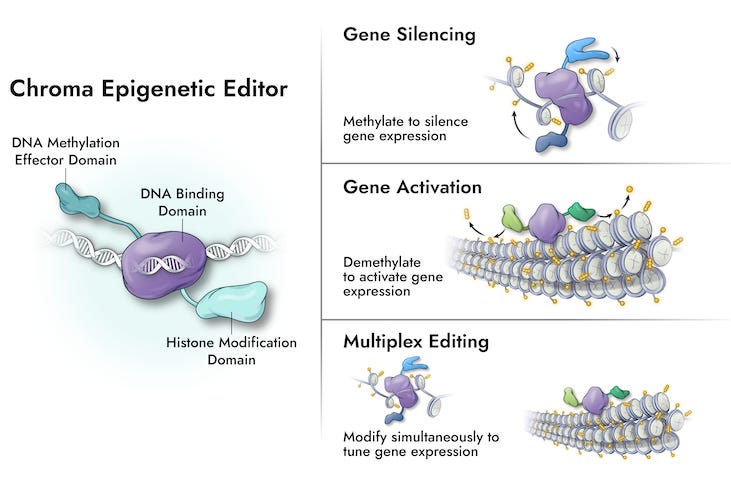
Chroma Medicine is pioneering a new class of genomic medicines that harness epigenetics, nature's innate mechanism for gene regulation, to revolutionize the treatment of genetically driven diseases. Founded in 2021, the company's suite of epigenetic editors are designed to specifically target and modify epigenetic marks, which are chemical modifications that regulate gene expression.
By altering epigenetic marks, the idea is to precisely control gene activity without changing the underlying DNA sequence. With the premise to build a safer alternative to traditional gene editing technologies that require cutting or altering the DNA sequence. However, work needs to be done to ensure durable changes of epigenetic markets that are stable & can persist for long periods of time. With this, Chroma is building out a pipeline of drug candidate for diseases from cancer to autoimmunity & neurological disorders.
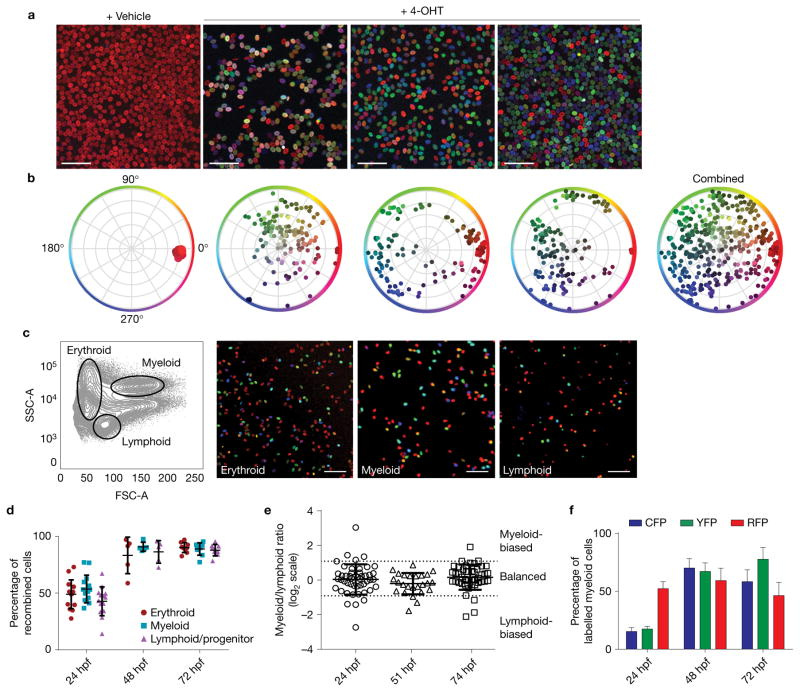
Clonal fate mapping quantifies the number of haematopoietic stem cells that arise during development
The paper investigates the number of hematopoietic stem cells (HSCs) that arise during development in zebrafish. HSCs are responsible for generating all of the blood cells in the body. Using two different methods to track the development of HSCs:
- Laser-induced fate mapping: using a laser to activate a gene that is expressed in HSCs. This gene then produces a fluorescent protein that can be tracked throughout the development of the HSC.
- Zebrabow labelling. this method uses a genetic technique to label HSCs with a unique combination of colors. This allows the authors to track the development of individual HSC clones.
Finding that both methods produced similar results. They estimated that there are approximately 30 HSC clones that arise during development in zebrafish. This number is similar to the number of HSC clones that have been estimated in other animals. The paper also found that the number of HSC clones can be affected by stress. For example, zebrafish that are exposed to irradiation or transplantation have fewer HSC clones. And providing new insights into the development of HSCs. Providing a PoC that can be used to study the development of HSCs in other animal models that can give insights into human HSC development.
https://www.nature.com/articles/ncb3444
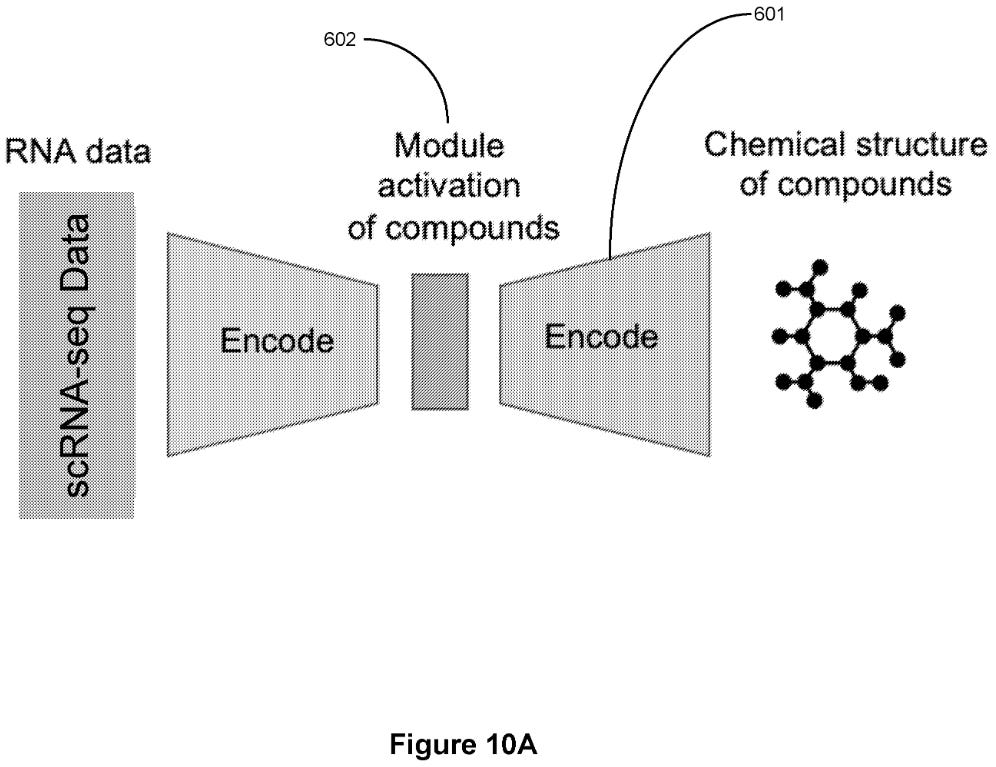
Systems and methods for associating compounds with physiological conditions using fingerprint analysis
The patent describes a method of associating a test chemical compound with a physiological condition of interest. With the following steps:
- Obtaining a fingerprint of the chemical structure of the test chemical compound
- Accessing a set of cellular constituent modules. Each cellular constituent module includes a respective independent subset of a plurality of cellular constituents.
- Retrieving, as output from a model, a respective activation score for each cellular constituent module in the set of cellular constituent modules
- Associating the test chemical compound with the physiological condition of interest when the activation score for the first cellular constituent module satisfies a first threshold criterion.
Where each cellular constituent modules are associated with the physiological condition of interest based on the correlation between the abundance of each cellular constituent in the module and the physiological condition. While the model is trained on a dataset of cell-based assay abundance values for each cellular constituent module and the physiological condition. And the threshold criterion is used to determine whether the test chemical compound is associated with the physiological condition.
https://patentimages.storage.googleapis.com/29/cf/2f/8c993e147834ac/US20220403335A1.pdf
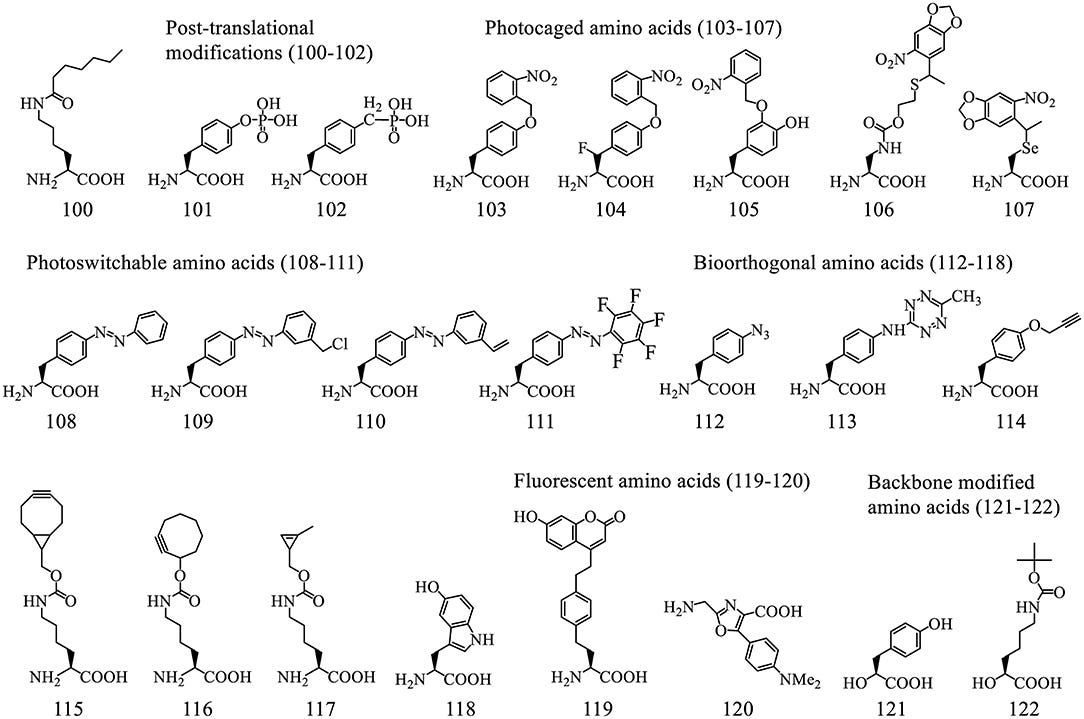
How are non-canonical amino acids produced?
Non-canonical amino acids are amino acids that are not encoded by the standard genetic code. And can be produced with genetic, enzymatic, and chemical methods:
- Post-translational modification: the most common method is to modify a canonical amino acid after it has been incorporated into a protein. For example, the amino acid serine can be modified to form the non-canonical amino acid phosphoserine by the addition of a phosphate group.
- Nascent chain aminoacylation: process that occurs during protein synthesis. In this process, a non-canonical amino acid is added to a growing peptide chain instead of a canonical amino acid. For example, the amino acid selenocysteine can be added to a growing peptide chain instead of cysteine.
- Genetic engineering: introducing genes that encode non-canonical amino acids into cells. This allows cells to produce proteins that contain non-canonical amino acids.
- Chemical synthesis: synthesis of non-canonical amino acids
Non-canonical amino acids are involved in protein folding, enzymatic activity, and signaling pathways. They are also being studied for their potential use in drug development; currently used in Ozempic. Phosphoserine is a modified form of serine that has a phosphate group attached to it. It is involved in protein phosphorylation, a process that is important for regulating many cellular processes. And selenocysteine is an amino acid that contains the element selenium. It is used to synthesize proteins that are involved in antioxidant defense and metabolism. N-formylmethionine, a modified form of methionine, is found in the N-terminus of protein, and involved in the initiation of protein synthesis. While O-phosphotyrosine is a modified form of tyrosine that has a phosphate group attached to its oxygen atom. And is involved in signal transduction pathways.
Founder Stories: Andrew Beck, Co-Founder and CEO of PathAI
PathAI provides comprehensive precision pathology solutions from wet lab services to algorithm deployment for clinical trials and diagnostic use