
Profiles in Biotech (9/10/23)
Analysis
Axial: https://linktr.ee/axialxyz
Axial partners with great founders and inventors. We invest in early-stage life sciences companies such as Appia Bio, Seranova Bio, Delix Therapeutics, Simcha Therapeutics, among others often when they are no more than an idea. We are fanatical about helping the rare inventor who is compelled to build their own enduring business. If you or someone you know has a great idea or company in life sciences, Axial would be excited to get to know you and possibly invest in your vision and company . We are excited to be in business with you — email us at info@axialvc.com

Kiniksa Pharmaceuticals acquires & develops drugs. With their lead product in-licensed from Regereron in 2017 - ARCALYST is an interleukin-1 trap approved by the FDA for the treatment of recurrent pericarditis (RP) and cryopyrin-associated periodic syndromes (CAPS).
Kiniksa is also developing Mavrilimumab, a monoclonal antibody (mAb) inhibitor targeting granulocyte-macrophage colony stimulating factor receptor alpha (GM-CSFRα). Vixarelimab, a mAb inhibitor of signaling through oncostatin M receptor beta (OSMRβ), for the treatment of prurigo nodularis and diseases characterized by chronic pruritus. And KPL-404, a mAb inhibitor of CD40-CD154 interaction, for the treatment of T/B-cell dependent mediated indications.

Human chimeric antigen receptor macrophages for cancer immunotherapy
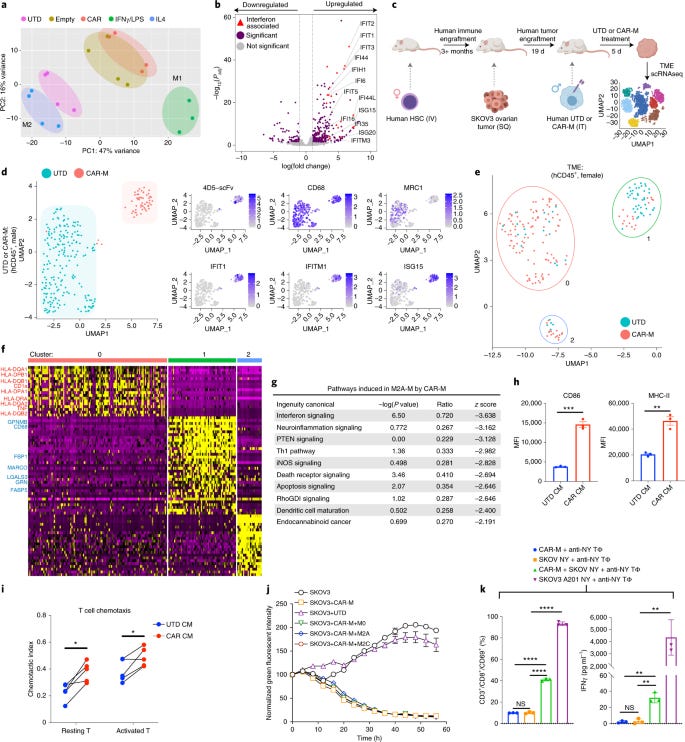
The paper uses genetically engineered human macrophages to target and kill cancer cells. Generating chimeric antigen receptors (CARs) that are specific to tumor-associated antigens, and then using a chimeric adenoviral vector to deliver these CARs to human macrophages. CAR-Macrophages created were able to specifically target and kill cancer cells in vitro and in vivo.
First testing the ability of CAR-Macrophages to target and kill cancer cells in vitro. Using a variety of tumor cell lines, including those expressing the HER2 and mesothelin antigens. The CAR-Macrophages were able to specifically target and kill tumor cells that expressed the CAR-specific antigen, while having minimal effects on non-cancerous cells.
Then measuring targeting/killing cancer cells in vivo. With 2 mouse models of cancer, one with HER2-positive breast cancer and the other with mesothelin-positive ovarian cancer. With the CAR-Macrophages able to significantly reduce tumor growth and improve survival in both mouse models. And were also able to induce a pro-inflammatory tumor microenvironment, which may help to promote the activity of other anti-cancer immune cells. Now conducting clinical trials, through Carisma Therapeutics, to test the safety and efficacy of CAR-Macrophages in humans.
https://www.nature.com/articles/s41587-020-0462-y
Methods And Compositions Comprising A Viral Vector For Expression Of A Transgene And An Effector
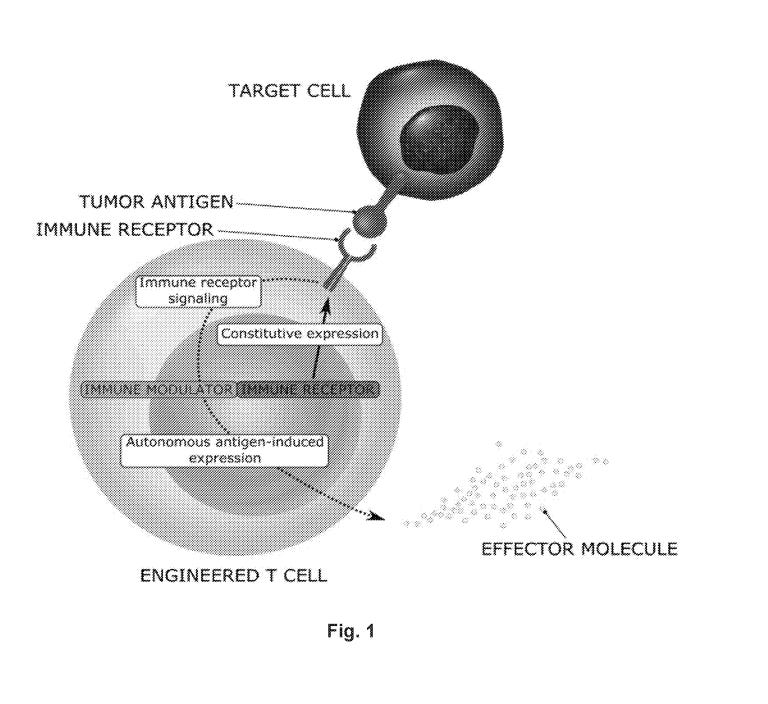
The patent covers a single viral vector made up of two polynucleotides. The 1st polynucleotide is a constitutive promoter operably linked to a nucleic acid encoding at least one transgene, such as a receptor subunit. The 2nd polynucleotide has an inducible promoter linked to a nucleic acid encoding an effector, such as a cytokine or an antibody fragment.
With applications for engineering immune cells by introducing the viral vector into the cells. Generating immune cells with additional functionalities, such as autonomous antigen-induced expression of immuno-modulatory molecules limited to the tumor microenvironment.
https://patentimages.storage.googleapis.com/0c/c7/e0/345b352c449ea6/US20210032661A1.pdf
How do integrin proteins work?
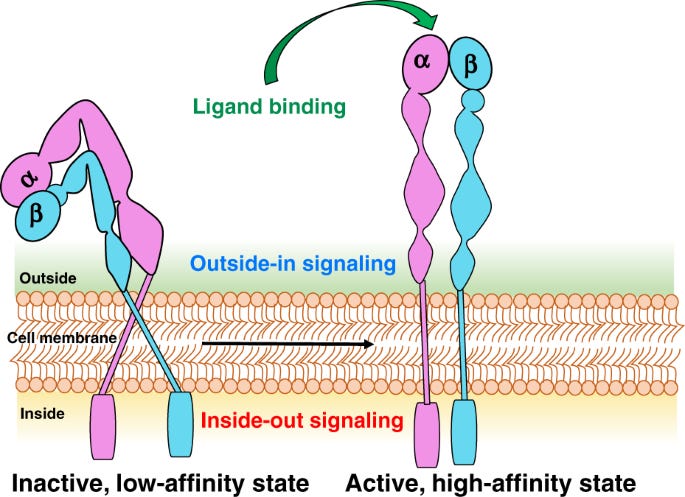
Integrins are a family of cell surface receptors that mediate the attachment of cells to the extracellular matrix (ECM). They are heterodimers, consisting of an α subunit and a β subunit. The α subunit binds to the ECM, while the β subunit links the α subunit to the cytoskeleton.
When integrins bind to the ECM, they undergo a conformational change that activates them. This activation leads to the recruitment of other proteins, such as signaling molecules and cytoskeletal proteins. These proteins then mediate a variety of cellular responses, such as cell adhesion, migration, and differentiation.
Integrins are involved in a wide variety of cellular processes:
- Cell adhesion: integrins binding to the ECM is essential for cell migration, tissue development, and wound healing
- Cell migration: when cells need to move, they extend pseudopods that attach to the ECM through integrins. The binding of integrins to the ECM then provides a force for the cell to move.
- Cell differentiation: for example, integrins are involved in the differentiation of blood cells
- Inflammation: when cells are damaged, they release molecules that activate integrins. This leads to the recruitment of immune cells to the site of injury.
- Cancer: cancer cells often express different integrins than normal cells. This allows them to attach to the ECM and metastasize to other parts of the body.
Scientist Stories: John Wherry, Systems Immunology and T-cell Exhaustion
The Wherry lab defines the nature of T-cell exhaustion from limited responses to antigen restimulation, high co-expression of inhibitory receptors & distinct transcriptional program