
Profiles in Biotech (8/28/23)
Analysis
Axial: https://linktr.ee/axialxyz
Axial partners with great founders and inventors. We invest in early-stage life sciences companies such as Appia Bio, Seranova Bio, Delix Therapeutics, Simcha Therapeutics, among others often when they are no more than an idea. We are fanatical about helping the rare inventor who is compelled to build their own enduring business. If you or someone you know has a great idea or company in life sciences, Axial would be excited to get to know you and possibly invest in your vision and company . We are excited to be in business with you — email us at info@axialvc.com

Florence Healthcare is a clinical trials platform that connects pharmaceutical companies with research sites. Providing a single view of clinical trial data, which can help to improve the efficiency and accuracy of clinical trials.
Florence also offers a variety of tools and services to help research sites manage their workflows:
- Site enablement: the company's flagship product is a dashboard for all clinical trial data
- eBinders: electronic versions of clinical trial binders that contain all of the documentation for a study. Making it easier to find and share documents.
- Remote monitoring: allows pharma companies to monitor clinical trials remotely, without the need for site visits
- Services: Florence also offers a variety of services to help research sites get started with clinical trials, such as training, consulting, and project management

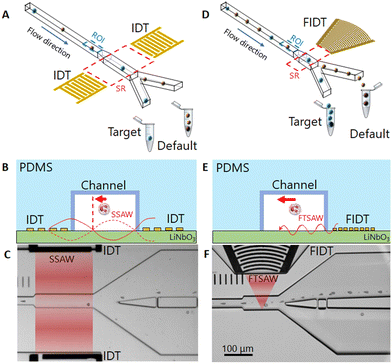
Image-based cell sorting using focused travelling surface acoustic waves
The paper describes a new method for sorting cells based on their physical properties. Using a combination of real-time deformability cytometry (RT-DC) and focused travelling surface acoustic waves (FTSAW).
RT-DC is a technique that uses microscopy to image cells as they flow through a microfluidic channel. The cells are then analyzed in real time for their size, deformability, and other physical properties. While FTSAW is a type of acoustic wave that can be used to manipulate the motion of cells. When a TSAW is applied to a cell, it creates a pressure gradient that can push the cell in a specific direction.
The authors integrated RT-DC and FTSAW into a single microfluidic device. This device allows cells to be sorted based on their physical properties, such as size, deformability, and brightness. Sorting different types of cells, including white blood cells, red blood cells, and cancer cells. They also sorted microgel beads and other particles.
Their method does not require the use of fluorescent dyes or other markers. This is important for applications where the cells cannot be labeled, such as in therapeutics. Sorting up to 400 cells per second. With use cases in drug screening and isolating rare cells from a heterogeneous population.
https://pubs.rsc.org/en/content/articlehtml/2023/lc/d2lc00636g
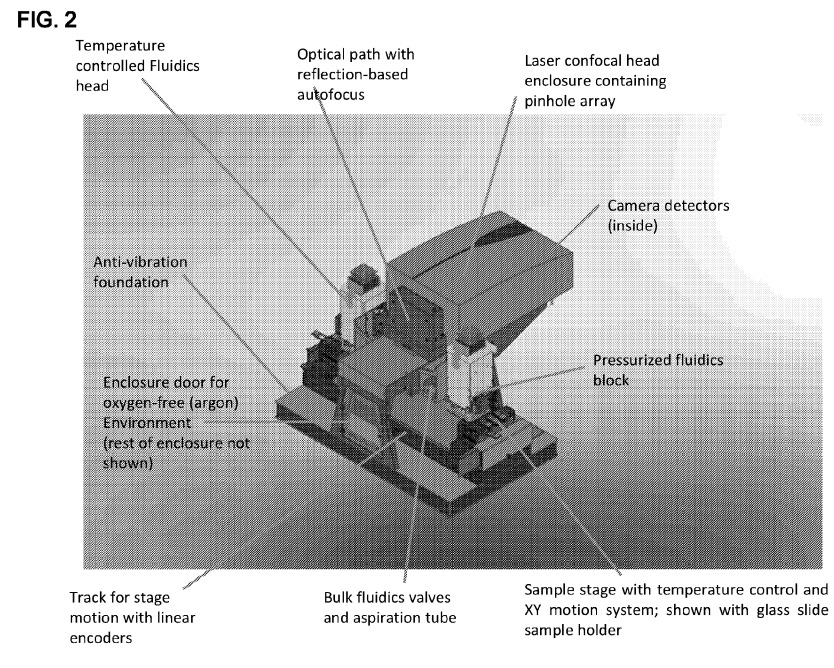
Method and apparatus for volumetric imaging of a three-dimensional nucleic acid containing matrix
The patent is for a method for volumetric imaging of a three-dimensional nucleic acid-containing matrix. And involves immobilizing the nucleic acids in a three-dimensional matrix, such as a polymer or a tissue sample. The nucleic acids are then be amplified and sequenced, and the three-dimensional location of each nucleic acid is determined.
With the apparatus for volumetric imaging including a light source, a detector, and a method for scanning the light source and detector over the three-dimensional matrix. The light source can be used to excite the nucleic acids, and the detector can be used to detect the emitted light. The scanning method can be used to create a three-dimensional image of the nucleic acids.
With applications to study the spatial distribution of nucleic acids in cells and tissues. Identifying and quantifying nucleic acids in complex mixtures. As well as monitoring the expression of genes over time.
https://patentimages.storage.googleapis.com/e3/05/23/40237503142647/AU2023202795A1.pdf
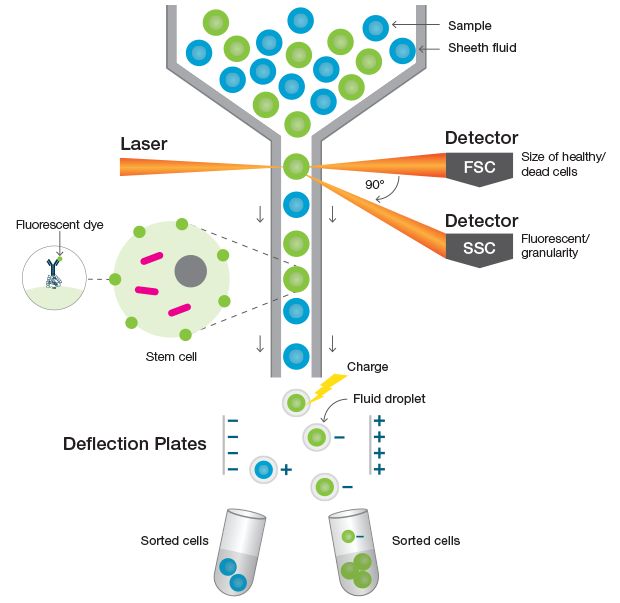
What is the workflow for FACS sorting?
- Sample prep: cells to be sorted are first stained with fluorescently labeled antibodies that target the cell surface markers of interest
- Flow cytometry: the stained cells are then introduced into a flow cytometer, where they are passed one at a time through a laser beam. The laser light scatters off the cells, and the amount of scatter is used to determine the cell size and granularity. The cells may also emit fluorescence light, which is detected by the flow cytometer.
- Data analysis: the data from the flow cytometer is analyzed to identify the cells of interest. This is done by setting up gates, which are regions of the data that define the cells that you want to sort.
- Cell sorting: while flow & data analysis is done concurrently, once the cells of interest have been identified, they are sorted by the flow cytometer. This is done by applying an electrical charge to the cells, which deflects them into different collection tubes.
Scientist Stories: Aviv Regev, Breakthroughs in single-cell genomics
Aviv Regev is a pioneer of single cell genomics and computational & systems biology. Currently the Executive Vice President and Head of Research and Early Development at Genentech/Roche.