Next-Generation Surrogate Wnts Support Organoid Growth and Deconvolute Frizzled Pleiotropy In Vivo
Inventors & their inventions
Axial: https://linktr.ee/axialxyz
Axial partners with great founders and inventors. We invest in early-stage life sciences companies such as Appia Bio, Seranova Bio, Delix Therapeutics, Simcha Therapeutics, among others often when they are no more than an idea. We are fanatical about helping the rare inventor who is compelled to build their own enduring business. If you or someone you know has a great idea or company in life sciences, Axial would be excited to get to know you and possibly invest in your vision and company. We are excited to be in business with you — email us at info@axialvc.com
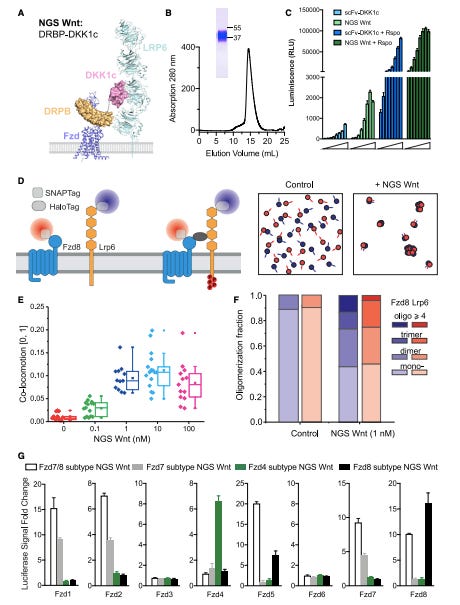
The research invents next-generation surrogate (NGS) Wnt molecules, which are water-soluble and designed to specifically activate different Frizzled (Fzd) receptor subtypes. NGS Wnts potently activate canonical Wnt/β-catenin signaling by clustering Fzd receptors with the co-receptor Lrp5/6. They show improved signaling potency compared to previous surrogate Wnt molecules.
NGS Wnts support the growth of multiple types of organoids, including colon, pancreas, ovarian, breast, and liver organoids. They show enhanced organoid proliferation and maintenance compared to standard Wnt3a conditioned media. NGS Wnts also greatly improve the efficiency of generating organoids from single cells across several organoid models. This has utility for genetic manipulation with CRISPR and establishing patient organoid biobanks.
In vivo administration shows tissue-selective systemic activity of the Fzd subtype-specific NGS Wnts. Different Fzd receptors mediate Wnt responses in intestinal crypt proliferation vs liver zonation homeostasis. The selective NGS Wnts can help deconvolve the contributions of specific Fzd receptor subtypes to Wnt pathway activation in different biological contexts.
In summary, NGS Wnts are useful as superior organoid growth factors, provide a toolkit to dissect Fzd receptor functions, and have potential utility for regenerative medicine applications.
https://www.cell.com/cell-stem-cell/fulltext/S1934-5909(20)30358-1