
Axial - Observations #6
Life sciences reflections
Build with Axial: https://axial22.axialvc.com/
Axial partners with great founders and inventors. We invest in early-stage life sciences companies such as Appia Bio, Seranova Bio, Delix Therapeutics, Simcha Therapeutics, among others often when they are no more than an idea. We are fanatical about helping the rare inventor who is compelled to build their own enduring business. If you or someone you know has a great idea or company in life sciences, Axial would be excited to get to know you and possibly invest in your vision and company . We are excited to be in business with you - email us at info@axialvc.com
Observations #6
A set of ideas and observations from a week’s worth of work analyzing businesses and technologies.
Diagnostics and IP
How strong of technical moats do diagnostic companies really have? Two court cases, Mayo v. Prometheus Laboratories (2012, Supreme Court) - https://en.wikipedia.org/wiki/Mayo_Collaborative_Services_v._Prometheus_Laboratories,_Inc. and Vanda Pharmaceuticals v. Ward Pharmaceuticals (2018 Federal Appeals Court) - https://www.patentdocs.org/2018/07/uspto-issues-memorandum-on-vanda-pharmaceuticals-v-west-ward-pharmaceuticals.html are two major legal decisions that influence that moat.
In 2012, the US Supreme Court ruled that optimizing the dose of a drug based on the metabolites of that drug were being directed by a law of nature and were patent-ineligible. In 2018, the US Court of Appeals for the Federal Circuit ruled in a case where the dose of a drug (iloperidone for schizophrenia in the case) was determined by the patient’s genotype was valid for patent protection because the claim “[applies]” natural laws and are not “directed to” them. The 2018 case led to a lot of diagnostic patents being revised; however, these two cases are pretty important for any diagnostics business. What this means is that for a technical moat to be valid, a company needs to operate on their data. Whether it’s creating a set of biomarkers to predict disease. Maybe just applying machine learning suffices. But the idea of just discovering a novel signal for disease and using it is not enough for protection from competitors.
CanoSino and a COVID-19 vaccine
There are a lot of companies working on a vaccine for COVID-19 to help restore some level of normalcy in our society. There’s a lot of hype around nucleic vaccines being developed because they were the first to enter the clinic. However, the companies with the best shot to produce an effective vaccine seem to be Sanofi/GSK and CanoSino. The latter is developing an adeno-associated virus (AAV) as a vaccine vector:
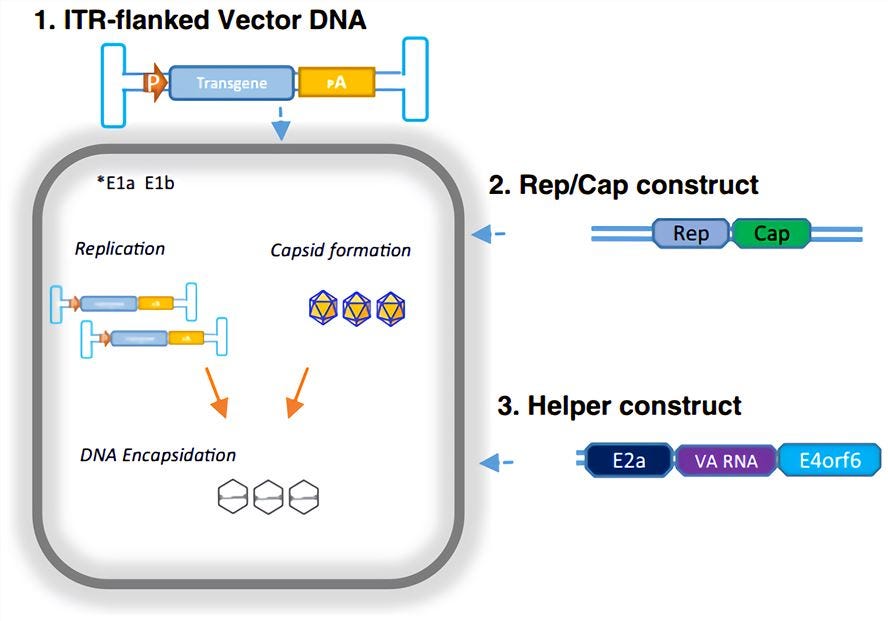
Source: Creative Biolabs
CanSino’s vaccine candidate (Ad5-nCoV) uses an AAV5 vector to deliver and express the full-length spike protein of SARS-CoV-2 - https://www1.hkexnews.hk/listedco/listconews/sehk/2020/0318/2020031800009.pdf The idea is to use an AAV as the vehicle to present the spike protein to the immune system. The key readouts are antibodies produced against the spike protein and neutralizing antibodies against SARS-CoV-2 - https://clinicaltrials.gov/ct2/show/NCT04313127 A key issue is the tissue tropism (AAV5) and whether it will be available in certain tissues to induce a recognition and a strong immune response. Versus say mRNA modalities, AAV have a track record in the clinic, non-pathogenicity, high protein expression, and low inflammatory potential. This program is not getting enough attention, at least in the US, CanoSin was able to use the same technology for an Ebola vaccine in 2017 and based on the trial design and early data, seem poised to do something similar for COVID-19. Then vaccine manufacturing becomes a very important issue.
Biosecurity
How to reward defense and not only offense in life sciences and healthcare? Barring large regulatory changes, I don’t have strong conviction that this shift can occur. Business models around antibiotics have found difficulties over the last 2 decades to grow (i.e. Achaogen). Diagnostics especially around prevention have small numbers of reimbursement codes and are not used as widely needed.
What types of businesses around biosecurity are needed?:
Need ways to discover and design antibiotics
Early detection from cancer to infectious and viral disease
Monitoring and detection of bioweapons
Food security (the profitability and technology adoption in agriculture is another large problem; the margins are so low that companies are more risk averse)
Others?
The Avian Flu
A buddy of mine Ben (who is really good) - https://www.linkedin.com/in/benjamintseng/ - wrote an article almost 14 years ago on pandemics and how to prepare for them when the H5N1 outbreak occurred - https://benjamintseng.com/wp-content/uploads/2019/02/Avian-Flu-Next-Generation.pdf Some of the quotes are prescient:
With the specter of pandemic hanging over the world, the obvious question is "what can be done?" The answer, however, is contextual, as Osterholm points out, "What we need to do depends a great deal on when the epidemic happens. If it happens in ten years, then the use of vaccines can play a big role. If it happens tonight, we're somewhat screwed with regards to the vaccine." To Osterholm, the critical thing, beyond the obvious stockpiling of drugs and vaccines, needs to take place on a global level, "Much of the world just doesn't understand the seriousness of the problem and hasn't given enough attention or resources into properly planning for a pandemic." This is an oversight which is particularly fatal when dealing with a disease which pays no attention to political borders, and, to Dr. Osterholm, can only be dealt with if a unified and worldwide effort is made at surveillance and towards production and testing of a universal vaccine
When asked the same question, Dr. Hayden focused a good deal on the issue of "surge capacity," the ability of a health infrastructure to cope with a sudden increase in the need for critical healthcare. On the subject, Dr. Hayden noted, "one dilemma that we face in the United States is the great focus on cost efficiency to the point where there is very little surge capacity in hospitals in terms of beds and staffing.
We have a quarter of the hospital beds per capita that Japan and Switzerland have, most of which are occupied, creating doubt in what would happen if many more people required hospital care." To Dr. Hayden, this same problem existed also in our drug and vaccine manufacturing technology: "[Our] goal is to develop a [vaccine] production technology that can be quickly and effectively ramped up to full capacity."