
Axial - Observations #45
Life sciences reflections
Build with Axial: https://axial22.axialvc.com/
Axial partners with great founders and inventors. We invest in early-stage life sciences companies such as Appia Bio, Seranova Bio, Delix Therapeutics, Simcha Therapeutics, among others often when they are no more than an idea. We are fanatical about helping the rare inventor who is compelled to build their own enduring business. If you or someone you know has a great idea or company in life sciences, Axial would be excited to get to know you and possibly invest in your vision and company . We are excited to be in business with you - email us at info@axialvc.com
Observations #45
A set of ideas and observations from a week’s worth of work analyzing businesses and technologies.
Industrial enzymes
Enzymes are a core part of industrial biotechnology. They catalyze important chemical reactions to produce new products from detergents to specialty chemicals. The field has undergone roughly 4 eras:
Enzymes from animal sources - early 1900s
Enzymes from microbial sources - mid 1900s
Enzymes from genetic engineering - 1980s to now (Novozymes has been dominant here)
Enzymes from software - now
The industrial enzyme market started taking off in the 1960s with what would become Novozymes starting work in the 1940s among other companies. In the 1980s, in the backdrop of the biotechnology revolution, companies like Genentech with Genencor (now part of DuPont), Novo, and Genex started using cloning and genetic engineering on bacterial/fungal strains to start producing enzymes with higher yields and new functions. Genencor in particular did great work to bring new enzymes to products like Tide and ethanol. The workhorse for this period of growth was the host, bacterial or fungal, and deep-tank, fed-batch aerobic fermentation. On this, there is a large opportunity to pick different hosts specific for a given problem. Colorado Biofactory is leading the way here. With applications from food and plastics to energy and textiles, the addressable market for enzymes is in the $10Bs.
The key theme for enzymes is replacing organic chemistry. Organic synthesis often leads to environmentally-harmful byproducts but have logical steps to produce a target molecule. Whereas enzymes are useful to produce a natural reaction/product but are not characterized well enough to significantly eat away at organic chemistry’s use. This creates an opportunity to go through the large search space of enzymes and the reactions they catalyze to map out specificity, catalytic rate, and activity. A database of millions of these enzymes along with these features could create the standard. This would enable logical steps to use enzymatic reactions to produce a target molecule.
Bringing more engineering principles to this field is an important driver. Synthetic biology and new tools can build large libraries of enzymes and screen for functional variants. The key themes here are:
Standardization of parts – makes screening and discovery reproducible and scalable
Coupling screening to the synthesis and assembly of DNA
Modularity of parts between multiple chassis
More predictable outcomes – as more data is collected through screens various combinations of components will be discovered not to work together
These principles create a tight feedback loop between new models and biology experiments to make novel predictions. As more experiments are conducted, a company can build a large knowledge base of what experiments not to do and reduce the search space to valuable enzymes with new functionality.
Successful case studies like Novozyme, Solugen, and Genencor initially pursued low-hanging fruit and expanded their platform to solve larger-and-harder problems. Applications for industrial enzymes span drug development, consumer products, and industrials. Software unlocking new enzymes through better genomics analysis (finding new biosynthetic clusters) and design can discover enzymes that catalyze difficult chemistries (i.e. C-C) and expand the toolkit to help patients and our environment.
Avastin - drugs that are their own pipelines
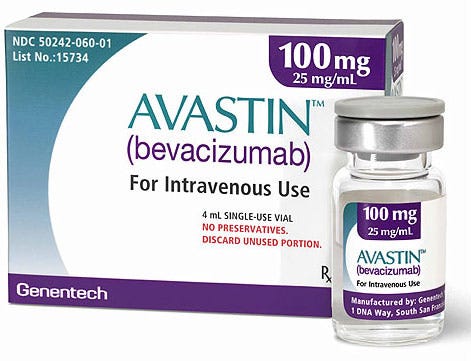
Avastin is an anti-VEGF-A antibody developed by Genentech and approved for a wide-range of solid tumors as well as used off-label to treat wet AMD. In 2004, Avastin’s first FDA approval was in metastatic colorectal cancer. The drug gained approval for advanced lung cancer in 2006 and for kidney cancer and glioblastoma in 2009. In 2014, Avastin was approved in metastatic cervical cancer and gained another five approvals from there. The drug was part of some controversy with its 2008 approval for advanced HER2-negative breast cancer and subsequent market pullout in 2011 after more clinical data was observed to show Avastin did not have a significant effect over the standard-of-care.
In 1989 during a research project in cardiovascular disease, Napoleone Ferrara and his group at Genentech were the first to clone vascular endothelial growth factor (VEGF), which is essential for angiogenesis (i.e. new blood vessel growth). The idea the group started exploring, enabled by Genentech’s science-first culture, was the anti-cancer effects of inhibiting angiogenesis? Past studies found a connection between blood vessel development and tumor growth. A theme here was that the Genentech group was bringing new technologies (cloning and antibodies) to an old problem. In 1993, the group discovered an antibody that inhibited VEGF and led to reduced tumor growth in a mouse model. Once a humanized version of the antibody was developed, what would become Avastin entered trials.
With such a broad mechanism-of-action (MoA), Genentech initiated trials for Avastin across a wide-range of cancers. The drug failed to meet its primary endpoint in 2002 for a phase 3 3rd-line breast cancer trial. A pivotal phase 3 trial (n=925) in metastatic colorectal cancer showed Avastin increased progression-free survival by 5 months over the standard-of-care. The drug gained approval for the disease in 2004, 15 years after the first cloning of VEGF. Genentech continued to explore the application of inhibiting angiogenesis for more cancers leading to several more approvals for Avastin over the next decade.
Avastin became a pipeline-in-a-pill for two main reasons:
Relying on a broad MoA mediated through VEGF that is connected to several solid tumors and even eye disease. Having a first mover advantage definitely helped Genentech as well.
Bringing new technologies to explore an old problem: the role blood vessel formation in cancer growth
Rituxan - drugs that are their own pipelines
Another case study for the pipeline-in-a-pill strategy is also from Genentech through a collaboration with IDEC (now Biogen) - Rituxan was the first antibody therapy approved for cancer. It targets CD20 for patients with non-Hodgkin's lymphoma (NHL), chronic lymphocytic leukemia, rheumatoid arthritis, granulomatosis with polyangiitis, microscopic polyangiitis, and pemphigus vulgaris. Rituxan is also frequently used off-label for diseases such as primary thrombocytopenia, immune thrombocytopenic purpura, macroglobulinemia, autoimmune hemolytic anemia, Burkitt lymphoma, multiple sclerosis, Wegener granulomatosis, post-transplant lymphoproliferative disorder, bullous dermatoses and hypogammaglobulinemia.
Rituxan got its start from the research (around 1975) of Ronald Levy at Stanford. As a young professor, he worked on a project to develop an antibody against patient-specific surface antibodies (Ig) found on lymphoma cells. In 1981, antibodies discovered from this project were used to treat the first lymphoma patient and around 50 thereafter. In 1985, IDEC Pharmaceuticals was founded to commercialize this research. However, the company couldn’t find a cost-effective way to scale up the personalized treatment and pivoted toward CD20, a more general B-cell target. The premise was to target CD20 to deplete B-cells (normal and malignant) from a patient’s blood and bone marrow while sparing memory B-cells.
After engaging in an antibody discovery project for CD20, a candidate (C2B8) was found. In 1992, an investigational new drug (IND) application was filed with positive data from a phase 1 trial in 1994 (6/15 patients had a tumor regression). However, IDEC was struggling to raise more capital to run the clinical trials. The company was developing an entirely new modality, monoclonal antibodies, for an indication that was seen as a small market, NHL with annual cases of around 40K. IDEC’s deal with Genentech in 1995 started off with a lunch and provided the capital necessary to develop Rituxan. After a successful pivotal trial (n=166), Rituxan gained its first FDA approval in NHL in 1997. Subsequent clinical studies showed combining Rituxan with chemotherapy had an even stronger effect and led to its use as a first-line therapy. Even after almost 3 decades since the start of Rituxan’s first trial, the drug is still going strong as a standalone, combination, and maintenance treatment treating around 500K patients per year.
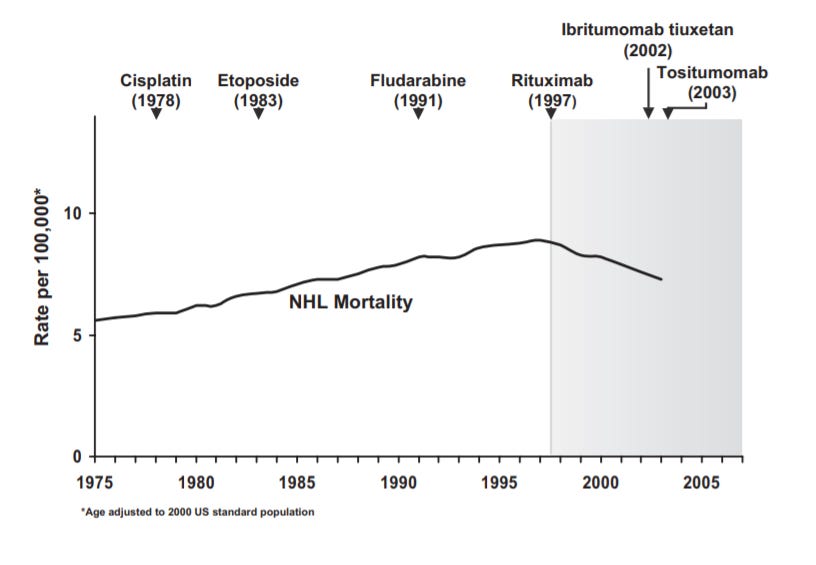
Rituxan was the first monoclonal antibody approved to treat cancer showing the power of more precise medicines - the drug had an almost immediate impact on NHL mortality. The drug also paved the way for the success of other antibody medicines like Herceptin and Avastin. Rituxan also became a pipeline-in-a-pill for several reasons:
Using a new technology, mAbs at the time, to bring more precision to a disease than the standard-of-care. Opportunities in cell therapies, stapled peptides, and gene therapies would be comparables now.
Pursuing an indication(s) with relatively slower progression. This enabled Rituxan to be used for maintenance treatments and have more opportunities to be combined with other therapies.
B-cell depletion has a pretty broad effect in both cancer and autoimmunity, and by creating the first antibody that targets B-cells, Rituxan had the market positioning to see what the effects would be in any disease driven by B-cells.
Source: https://www.annualreviews.org/doi/10.1146/annurev.med.59.060906.220345