Axial - Observations #44
Life sciences reflections
Build with Axial: https://axial22.axialvc.com/
Axial partners with great founders and inventors. We invest in early-stage life sciences companies such as Appia Bio, Seranova Bio, Delix Therapeutics, Simcha Therapeutics, among others often when they are no more than an idea. We are fanatical about helping the rare inventor who is compelled to build their own enduring business. If you or someone you know has a great idea or company in life sciences, Axial would be excited to get to know you and possibly invest in your vision and company . We are excited to be in business with you - email us at info@axialvc.com
Observations #44
A set of ideas and observations from a week’s worth of work analyzing businesses and technologies.
Cultured meats
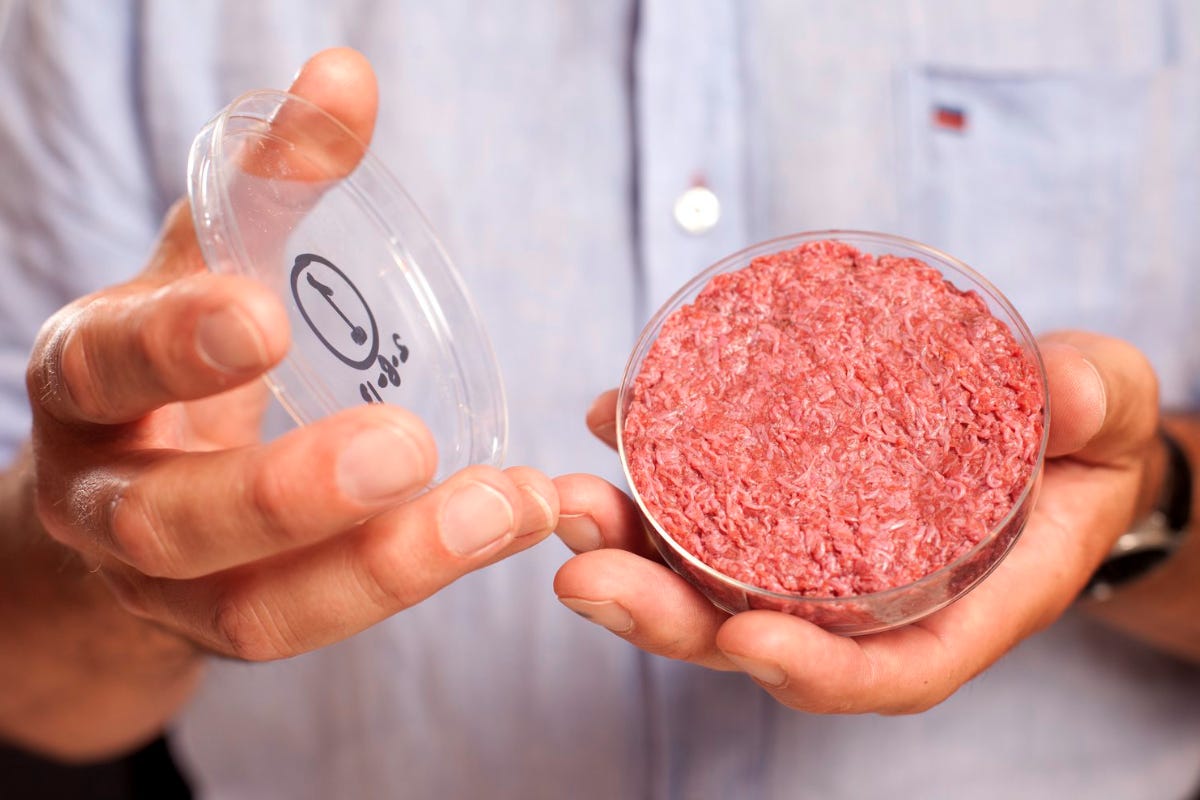
Cultured meats bring technologies developed over the last few decades in cell culture to food production. In 2013, the Post Lab at Maastricht University developed the first cultured meat product - a beef hamburger patty that cost around $300,000. This work led to the founding of Mosa Meat and kickstarted the current boom in cultured meats. In the current backdrop of the success in plant-based meats and technological advancements that make that same hamburger made in 2013 cost $10-$20 to produce today, cultured meats have the opportunity to transform the trillion-dollar industry spanning beef and poultry to seafood and pork.
With a biopsy from an animal, the cells (often stem cells that can be differentiated into muscle, fat cells) are grown in a nutrient-rich environment. Most growth medium contains fetal bovine serum (FBS), which is derived from dead calf blood. There is a need for serum-free media. During cultivation, more than 1 trillion cells (strands if muscle) are grown and can form complex structures depending on the scaffold and mechanical stress applied.
This process can potentially have several large effects on the meat industry and environment:
Having more ability to optimize meat for higher nutrition
Produce meat with different resources - cells versus animals. This has the potential to reduce land/water use and reduce methane emissions. Although more research is needed to understand these effects because the land impact is not exactly clear and fossil-fuel powered meat incubators might have the same carbon dioxide footprint as factory farming.
Reduce food contamination from salmonella and E. coli and the use of antibiotics. However, there are risks of using excessive hormones during the cultivation process for cultured meats.
Reconfigure the supply chain of protein sources
Contribute to feeding a larger global population with a current limit on arable land
With the recent commercial success of plant-based, and fungi-based, products driven by Impossible Foods and Beyond Meat, cultured meat companies can build on top of this market growth and increase consumer adoption for alternative meats. Current plant-based products are easier to produce than the cultured equivalent but have some limitations on texture, sensory experience, and taste. There is a large opportunity to bring new tools in machine learning and synthetic biology to solve this problem for plant-based foods. Cultured meats can solve this problem too by creating completely new products or as a hybrid with plant-based foods to make those more realistic.
The key themes that will enable new product development and business growth in the field are (1) regulatory, (2) partnerships, and (3) consumer adoption. In 2018, the US Department of Agriculture (USDA) and the US Food and Drug Administration (FDA) announced a joint regulatory framework for cultured meat products - the FDA will regulate the early stages of product development (i.e. inspect culturing facilities) and the USDA will oversee the process closer to commercialization (i.e. product packaging, cell harvesting). Globally, India, the EU, Singapore among others have taken similar steps to provide clarity for companies. Partnerships are enabling for new companies to gain distribution and institutional knowledge. Tyson investing in Memphis Meats is a great sign; however, more work needs to be done. Consumer adoption will be driven by cultured products having cost parity and similar texture/sensory/taste profiles as animal-derived meat.
Scaling production and new business models are 2 of the most important opportunities in cultured meats. Creating manufacturing processes that can produce 100Ks to millions of kg of meat at-or-near cost parity is essential for the field’s success. Moreover, moving beyond vertical integration for alternative foods in general has the potential to accelerate product development and create standards:
Building CDMOs that cultured meat companies can plug into and avoid implementing manufacturing themselves. Incumbents could easily move into this space but are currently hesitant due to the lower product margins versus drug development. This work has the potential to bring cultured meats to industrial scale.
Unlocking growth factors and standardizing growth media (along with bioreactors). Open source business models are an exciting solution to do this work. Another large opportunity is replacing FBS in large-scale production.
Cell line development with different growth features and biobanking requirements
New scaffolds to help cultured meats mimic the natural cuts from the fibers and connective tissue to blood vessels, nerves, and fat
New culturing techniques to include oxygen perfusion and micronutrient enhancement
If vertical integration is no longer a prerequisite, then cultured meat companies could license their products as meat products and ingredients
Humira - drugs that are their own pipelines
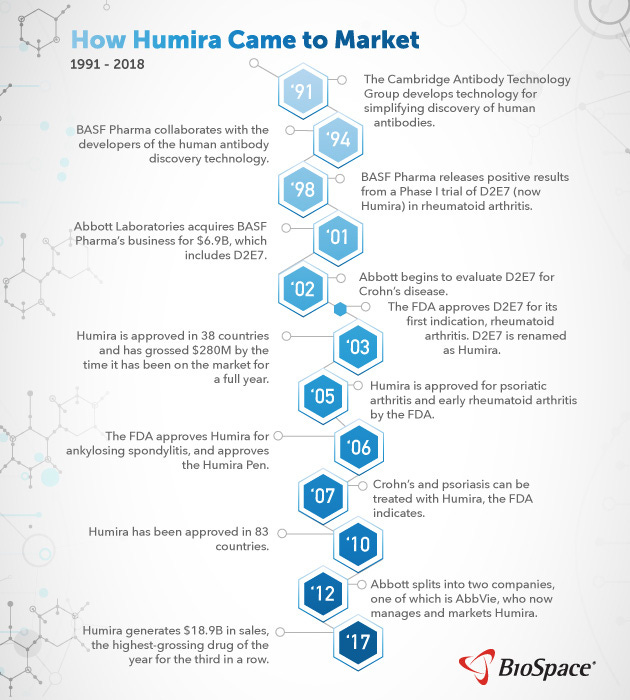
Humira is the best selling drug ever with well over $100B in cumulative sales treating over a million patients. The drug (adalimumab), which stands for Human Monoclonal Antibody In Rheumatoid Arthritis, is an anti-TNF monoclonal antibody to treat several autoimmune diseases from rheumatoid arthritis to Crohn's disease and psoriasis.
In the UK, Cambridge Antibody Technology (CAT) Group used their phage display technology in the 1990s to discover what would become Humira. CAT was founded by Greg Winter who recently won the Nobel Prize for the invention of phage display. Around 1993, CAT raised capital from Knoll Pharmaceuticals (BASF) who pushed CAT to develop an anti-TNF antibody. Within two years a drug candidate was discovered. In 1998, BASF reported positive phase 1 (n=140) for the drug candidate to treat rheumatoid arthritis (RA). After positive phase 2 data, a pivotal phase 3 trial was initiated in 2000. With this exciting clinical traction, Abbott Laboratories acquired BASF Pharma for $6.9B in 2000. Humira was approved by the FDA in 2002 for RA. By the end of 2003, the drug had been used in over 50K patients. Despite being the 3rd TNF-α antibody on the market, Humira had a better dosing schedule (weekly versus daily) and better tolerability, which drove quick market uptake. These advantages only grew with a 2006 approval for a self-injectable syringe to deliver Humira.
With this approval and a broad mechanism-of-action, Abbott saw the value of using Humira for more diseases: Crohn’s disease, psoriasis, psoriatic arthritis, ankylosing spondylitis, and juvenile RA. With each new approval, revenue went up quickly reaching $1B in annual sales and going over $6B by 2010. In 2013, Abbott Laboratories spun off their drug business into AbbVie. Humira now represents over half of the company’s sales.
Core US patents for Humira expired in 2016, but the drug is still a bestseller due to the barriers to entry for the development of generic biologics (biosimilars) and periphery patents that go into 2030. Humira has been able to become a pipeline-in-a-pill for several reasons:
Pursuing a target, TNF, that has a wide effect on several autoimmune conditions
Having a better dosing schedule versus competition
Easier delivery with the Humira Pen to patient self-injection
Investing in long-term clinical trials (eight-year studies) to comprehensively measure toxicity and other side effects. Particularly for TNF inhibitors, side effects are a major consideration, and this type of data package is an important advantage for Humira even with expiring patents.
These 4 factors have created a brand for Humira versus biosimilars and other TNF inhibitors like Remicade and Enbrel, which still last to this day