Axial - Observations #43
Life sciences reflections
Build with Axial: https://axial22.axialvc.com/
Axial partners with great founders and inventors. We invest in early-stage life sciences companies such as Appia Bio, Seranova Bio, Delix Therapeutics, Simcha Therapeutics, among others often when they are no more than an idea. We are fanatical about helping the rare inventor who is compelled to build their own enduring business. If you or someone you know has a great idea or company in life sciences, Axial would be excited to get to know you and possibly invest in your vision and company . We are excited to be in business with you - email us at info@axialvc.com
Observations #43
A set of ideas and observations from a week’s worth of work analyzing businesses and technologies.
ADCs
Antibody-drug conjugates (ADC) combines the specificity of an antibody and the killing activity of a conjugated cytotoxic agent. The 3 main components of an ADC are:
A monoclonal antibody - minimal immunogenicity, high affinity for a cancer-specific antigen, stability for a longer half-life, and internalization to deliver the cytotoxic agent
A cytotoxic agent - usually targeting DNA or microtubules to initiate cell death; ensure that the molecule can be conjugated to the linker, is water soluble, and is stable
A chemical linker - this is probably the most important part of an ADC and determines the drug’s PK/PD and stability; you have to make sure a linker only breaks in specific environments to avoid delivering the cytotoxic agent to healthy tissues, and linker’s come in 2 types: (1) cleavable that relies on the environment to become activated and (2) non-cleavable that relies on lysosomal degradation of the antibody to release the agent. For example, Adcetris (Seattle Genetics) uses a cleavable linker sensitive to proteases and Kadcyla (Genentech) uses a non-cleavable one.
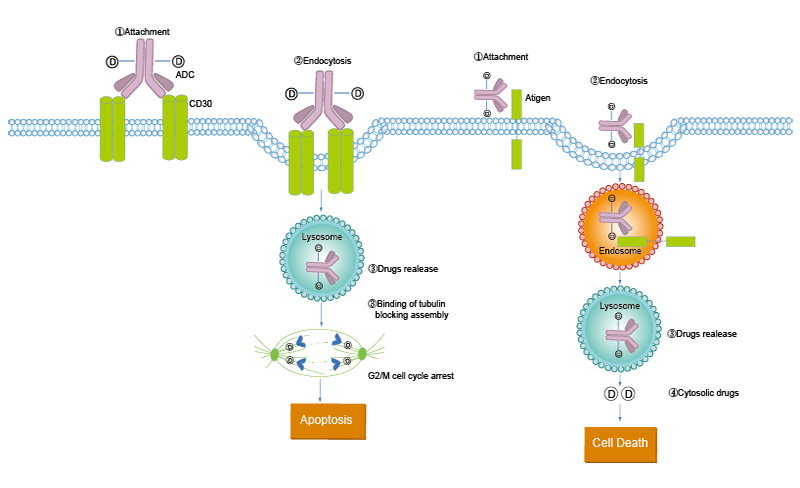
Once an ADC is designed, the drug modality leads to cancer killing through a series of steps that have to be accounted for during the design process:
The ADC binds an antigen through its antibody component
The ADC/antigen complex is brought into the cell through endocytosis
The linker is degraded. For ADCs with cleavable linkers, this step occurs within the endosome while in ADCs with non-cleavable linkers, the cytotoxic agent is released after protein degradation in the lysosome.
The cytotoxic agent is released
Apoptosis in the cell is initiated
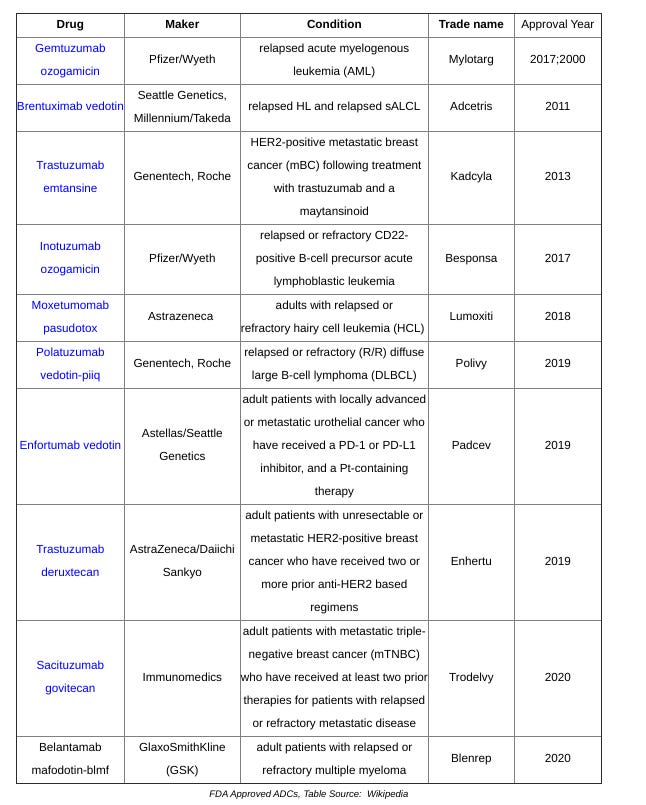
With 10 approved ADCs and over 80 trials ongoing, the field’s progress has seen a recent acceleration with 3 approvals in 2019 and 2 in 2020. The field has made a major comeback over the last 2 decades - companies have learned from past failures and have developed new linkers and chemistries to overcome the setbacks, mainly toxicity due to non-specific linkers, that many ADCs faced. Many of the new ADCs approved rely on the design of Seattle Genetics’ Adcetris, which was approved in 2011 for Hodgkin lymphoma and ALCL:
The 4 main problems ADCs have faced are:
Off-target effects mainly due to imprecise dosing
Low penetration into a tumor
Potency of cytotoxic agent
Stability problems that lead to shorter ADC half-lifes
Another way to look at ADCs are as a systemic chemotherapy. With the specificity of an antibody the selectivity of toxicity for cancer can be increased. The modality has always had promising data in model organisms that failed to translate into humans due to dosing problems. Developing better linkers can reduce off-target effects and expand the therapeutic window for an ADC when trials are initiated. The main levers for linker stability are the matching the type (cleavable versus non) to the environment and picking the right site on the antibody for conjugation. For the latter, the traditional conjugation sites on lysine and cysteine groups, due to their nucleophiles; however, specific sites are being engineered into antibodies to generate homogenous populations of ADCs.
For penetration, specifically for solid tumors, an ADC has to be able to generate a lethal concentration of the cytotoxic agent in all tumor cells. If distribution is heterogeneous, then some tumor cells are more likely to develop resistance to the ADC. A useful strategy here is to conjugate helper proteins, such as tissue-penetrating peptides, to the antibody. This is where costs can go up significantly during the design process for an ADC. Picking the right cancer model and measuring penetration across each run is essential for success.
An ADC’s drug-to-antibody ratio (DAR) combined with the cytotoxin itself determines potency. Increasing the ratio of cytotoxic agency attached to the antibody increases potency, but can lead to off-target effects if a linker is not specific enough. This is where the design process becomes important because balancing relationships like between a linker and DAR can make or break an ADC’s potential for approval. The main cytotoxic agents used are calicheamicins, auristatins, and maytansines.
Finally, a major consideration for ADC stability is managing the hydrophobicity of the cytotoxic agent, which can lead to ADC aggregation. Linker stability in blood is important to reduce off-target effects. Ultimately, the key to success for ADCs is designing the entire drug rather than focusing on optimizing for one component over another. New opportunities in the field are:
Inventing new linkers (mainly ones that react to new environments) and finding other ways to conjugate them to antibodies
Developing new penetrating agents to add to an ADC
Testing other cytotoxic agents
Implementing new stability moieties to the antibody
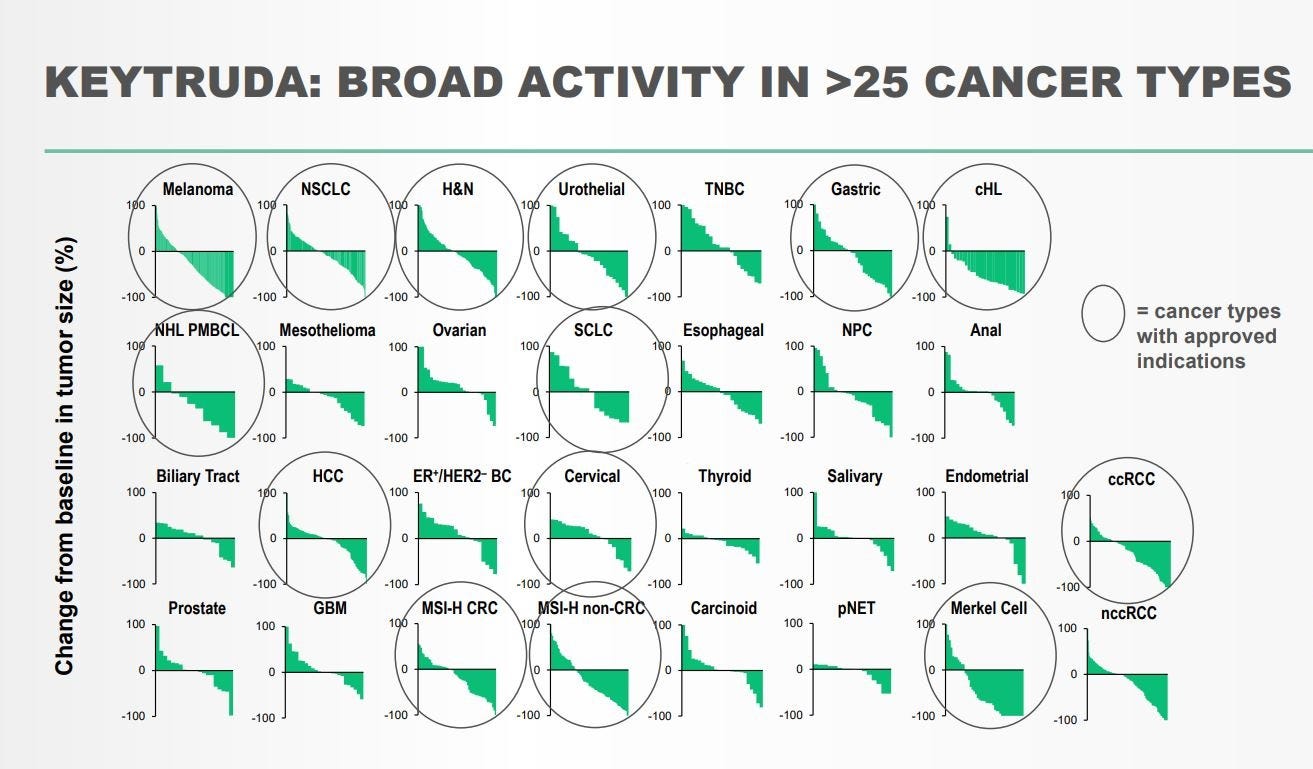
Keytruda - drugs that are their own pipelines
Keytruda (pembrolizumab), an anti-PD-1 antibody, is one of the most transformative medicines ever. Approved in 26 different diseases, the medicine is one of the best case studies of a pipeline-in-a-pill strategy. The drug was initially developed by Organon during an 2003 effort to find PD-1 agonists to treat autoimmunity. With the company discovering an PD-1 antagonist, they decided to pivot to cancer given the attention given to CTLA-4 inhibitors at the time. They developed a humanized version of the antibody and began planning clinical trials. But in 2007, Organon was acquired by Schering-Plough, which was acquired by Merck in 2009. After two handoffs, pembrolizumab was put on an out-license list by Merck. In 2010, Bristol Myers Squibb reported positive phase 3 data in the NEJM for an CTLA-4 inhibitor, Yervoy, in refractory metastatic melanoma. With this news along with rumors that Bristol’s Opdivo, which targets PD-1 as well, was showing promising results, Merck decided not to sell over pembrolizumab and began the first clinical trial in 2011.
Some of the key decisions during this time that has led to Keytruda’s massive success was due to the realization that Merck was about 5 years behind BMS in the development of an PD-1 inhibitor:
Use of biomarkers - Merck used PDL1 expression in tumors as a way to improve the odds of success for pembro. Even though biomarkers reduce the total number of addressable patients and make prescription a little harder, Merck chose to go down this route as a way to make up for lost development time.
Breakthrough designation - in 2012, the FDA implemented breakthrough designations, which increased the frequency of meetings with the agency and company. Merck took advantage of this regulatory change and got this designation for pembro.
Phase 1 expansion - when melanoma patients were observed to respond well to pembro, the phase 1 trial was expanded to add more advanced melanoma and lung cancer patients. The trial ended up recruiting over 1000 patients and became the largest phase 1 trial in cancer ever.
Focus on melanoma - pembro’s initial development in melanoma was driven by Yervoy’s initial success in the indication and their focus on advanced melanoma patients was not only made based on data but Merck’s desire to avoid comparator studies that could slow down clinical trials
In 2014, Keytruda was approved by the FDA to treat patients with advanced melanoma with a BRAF mutation. In 2015, the medicine was approved for PDL1-expressing metastatic non-small cell lung cancer (NSCLC). In 2016, Keytruda gained approval in recurrent.metastatic head and neck squamous cell carcinoma and as a first-line treatment for metastatic NSCLC. In 2017, driven by the discovery that microsatellite instability (MSI) is a marker for Keytruda responses, the medicine was approved in 5 different indications including the first approval based on a common biomarker, MSI. The drug picked up 6 more approvals in 2018 and has continued its impact on more-and-more cancers.