
Axial - Observations #34
Life sciences reflections
Build with Axial: https://axial22.axialvc.com/
Axial partners with great founders and inventors. We invest in early-stage life sciences companies such as Appia Bio, Seranova Bio, Delix Therapeutics, Simcha Therapeutics, among others often when they are no more than an idea. We are fanatical about helping the rare inventor who is compelled to build their own enduring business. If you or someone you know has a great idea or company in life sciences, Axial would be excited to get to know you and possibly invest in your vision and company . We are excited to be in business with you - email us at info@axialvc.com
Observations #34
A set of ideas and observations from a week’s worth of work analyzing businesses and technologies.
Mitohormesis
A recent preprint did an impressive job connecting mitohormesis, the nonlinear response to mitochondrial reactive oxygen species (ROS), to macrophage tolerance - https://www.biorxiv.org/content/10.1101/2020.10.20.347443v Out of the Saijo Lab at UC Berkeley with the lead author Greg Timblin (he would show up for the Friday RSF basketball games before COVID - he’s got some game), the work is a case study of the increasing understanding of mitohormesis in immunity and disease.
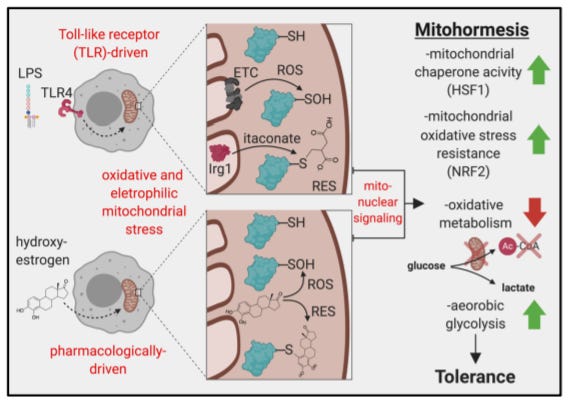
In response to stress, mitochondrial ROS (mtROS) is generated and cells respond nonlinearly to it. This phenomenon where the same agent at different concentrations can induce different responses is called hormesis. So mitohormesis gets the mito from mtROS and the hormesis from the nonlinear response curve. In model organisms, it has been found that small amounts of mtROS can promote lifespan whereas high doses cause systemic damage and increases mortality. The traditional view of ROS decades ago was that they were harmful but a deeper understanding of the biology is showing lower amounts of ROS can be protective.
Calorie restriction has been known to extend lifespan for decades. Genetic and mechanistic studies have shown a role of ROS as signalling molecules to activate defense pathways to protect the cell/organism from endogenous and exogenous stress. With this connection the work from the Saijo Lab does a great job to connect mitohormesis to the immune system. The premise is that macrophages generate mtROS to kill target pathogens and mitohormesis might play a role in the activity of macrophages. When a pathogen is encountered, ligands engage with toll-like receptors (TLR) to increase mtROS production in macrophages. The authors find that mitohormesis reduces expression of pro-inflammatory genes and induces tolerance toward the insult they tested: lipopolysaccharide. From this result, it seems mitohormesis protects macrophages from systematically damaging the body through overproduction of inflammatory cytokines. So the key observations here:
They use hydroxy-estrogens to induce mitohormesis in macrophages paving way for a new mechanism to reduce inflammation for say autoimmunity. This shows that lipophilic molecules would be good but hard starting points to begin to drug mitohormesis. So the idea is to induce some mitochondrial stress to reduce inflammation.
This goes against the idea that anti-oxidant are anti-inflammatory. Possibly, mito-hormetic medicines would be more effective here.
The next step is to understand the mitochondria-nuclear signalling that connects mtROS to reduce gene expression. The mechanism may be through epigenetic modification.
The role of mitochondria in immune activity and tolerance?
Off-the-shelf cell therapies
Allogeneic, off-the-shelf, cell therapies are sourced from a single donor and engineered to reduce graft-versus-host disease (GvHD) in patients. These types of medicines have similar logic to a HSC transplant or an organ transplant: evade or suppress the immune system to graft. On the other hand, autologous cell therapies are sourced from each patient, engineered, and then re-infused into the same patient.
Autologous cell therapies have transformed blood cancer patients with the approval of Yescarta (Kite/Gilead) and Kymriah (Novartis) with more to come and progress against solid tumors and autoimmunity. Manufacturing these medicines has been a major bottleneck to their growth. For example, manufacturing costs for Yescarta or Kymriah is around $80K per dose accounting for over a quarter of the total cost of the cell therapy. Beyond cost, logistics is a major problem from taking blood from patients, engineering their T-cells, expanding these cells without exhausting them, and reinfusing them into a patient. This is a problem set companies like Vineti are working on. Scaling up this process will be the driving force behind the success for autologous cell therapies. The goal ought to be making autologous cell therapy manufacturing match up with the timing between prescription and administration: days versus weeks (17-22 days) now.
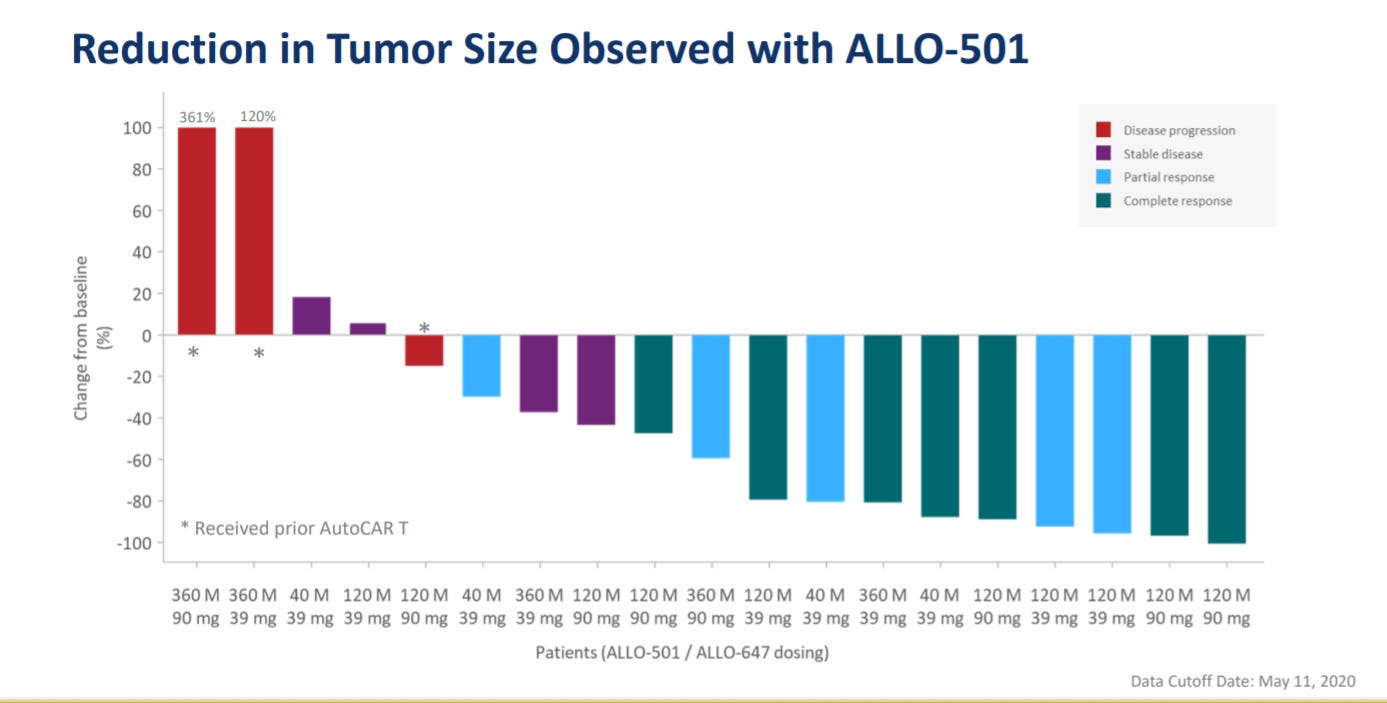
Allogeneic cell therapies are working to sidestep these logistic and manufacturing issues by sourcing cells from a small subset of patients. The leader in the field is Allogene Therapeutics. The company’s lead asset is an allogeneic anti-CD19 cell therapy for lymphoma in phase 1. The company is able to dose their patients within days of enrolling. To reduce GvHD, Allogene knocks out part of the TCR in their CAR-T cell therapies, which is involved in HLA matching between the donor and recipient. Earlier this year, the company reported clinical results from the phase 1 study - excitedly no GvHD was observed with similar efficacy of autologous CAR-T cell therapies - https://ascopubs.org/doi/abs/10.1200/JCO.2020.38.15_suppl.8002 and https://www.allogene.com/resources/download/First-in-Human-Data-of-ALLO-501-and-ALLO-647.pdf
The next few years of clinical data for off-the-shelf cell therapies will be exciting. Is knocking out parts of the TCR or MHC sufficient to reduce GvHD in patients? Can autologous cell therapy manufacturing get turnaround time to days?
PhD TikTok stars
Biology has the potential to build transformative consumer products. It has already transformed food, household products, and more. There’s a new crop of synthetic biology companies making cultured meats, plant-based foods, microbial products for consumers. Beyond scaling issues and reaching price parity, distribution strategy is probably more important. Recent success stories like Impossible Foods have relied on co-branding to grow; however, there is a massive opportunity for a new biology company to have a significant distribution advantage that finds a technical low-hanging fruit to work on: probably something around plant-based foods.
On the Internet, customer acquisition costs are really high because Google and Facebook have a monopoly on digital ads. So going to a few million dollars in revenue might be feasible but getting to $100Ms and $1Bs for a consumer company in general is pretty hard. Google and Facebook will throttle your ad exposure because they don’t want one company’s ad to be predominantly shown to their users. As a result, a consumer biology company, and any DTC company for that matter, need to have a built in audience to scale. Product quality matters, but the nice thing about biology is that it can be versioned. So the 2.0 and 3.0 products will likely be much better. A biology company with built-in distribution can generate capital to invest in R&D. Rather than figure out some technical problem and hope their breakthroughs generates enough consumer interest - this probably doesn’t work unless a company makes a pet dragon or equivalent.
A PhD TikTok star has a shot at building an iconic biology company. Are there any out there? If so, please email me or just send over their profile? Thank you.
Seven Powers cont.
The last of the seven powers is process power. This is an advantage of within a company that leads to a better product or lower costs. Think of the design team at Apple or the DBS team at Danaher, respectively. This power is a lot different than just good execution or operations. Process power is centered around creating operational barriers that require time and tacit knowledge for others to surmount.
Toyota is an incredible example in car manufacturing. Danaher was actually inspired by Toyota and repurposed the Toyota Production System for industrials and now molecular diagnostics. Danaher and Toyota’s systems rely on complexity from logistics, manufacturing, and various process improvements. Over time, through tinkering and trial and error, these systems evolve and improve, which generates tacit knowledge that is passed on through the organization.
Where does process power exist in life sciences? WuXi is probably the best example. They offer low cost biopharma services at scale. Their power is a consequence of 2 decades of improvement and an ever growing complex web of customers and partners. Danaher is another example with their ownership of Beckman Coulter and Cepheid. EQRx is building up a similar power through the data and clinical know-how to quickly become a second mover in drug development. Any others?