Axial - Observations #33
Life sciences reflections
Build with Axial: https://axial22.axialvc.com/
Axial partners with great founders and inventors. We invest in early-stage life sciences companies such as Appia Bio, Seranova Bio, Delix Therapeutics, Simcha Therapeutics, among others often when they are no more than an idea. We are fanatical about helping the rare inventor who is compelled to build their own enduring business. If you or someone you know has a great idea or company in life sciences, Axial would be excited to get to know you and possibly invest in your vision and company . We are excited to be in business with you - email us at info@axialvc.com
Observations #33
A set of ideas and observations from a week’s worth of work analyzing businesses and technologies.
The Novozymes Opportunity
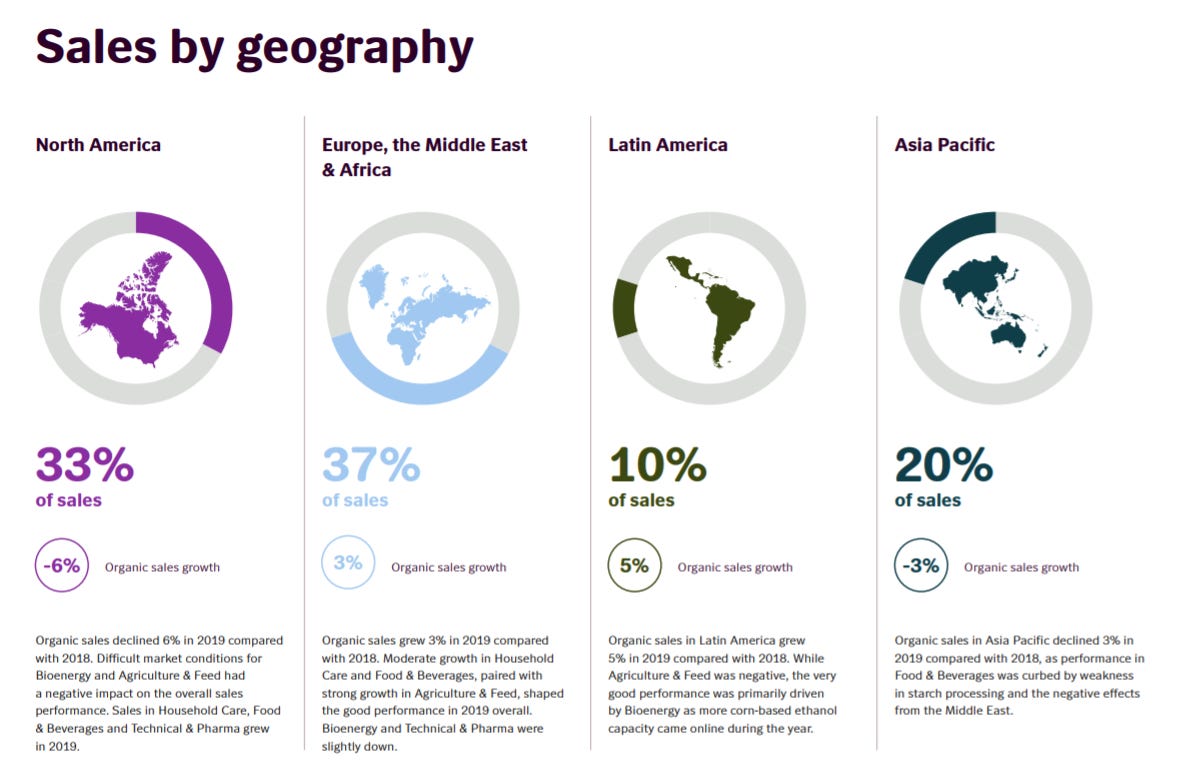
Novozymes is one of the most dominant enzyme companies in the world holding a little under half the market. The company focuses on industrial enzymes, ingredients, and microorganisms developing products across over 40 industries from agriculture to household care. With over $2B in annual revenue with a ~28% EBITDA margin, Novozymes’ margin represents a massive opportunity for new companies and at the same time potentially undervalues the enzyme market.
Enzymes are proteins that catalyze chemical reactions and have undergone roughly 4 eras:
Enzymes from animal sources - early 1900s
Enzymes from microbial sources - mid 1900s
Enzymes from genetic engineering - 1980s to now (Novozymes has been dominant here)
Enzymes from software - now
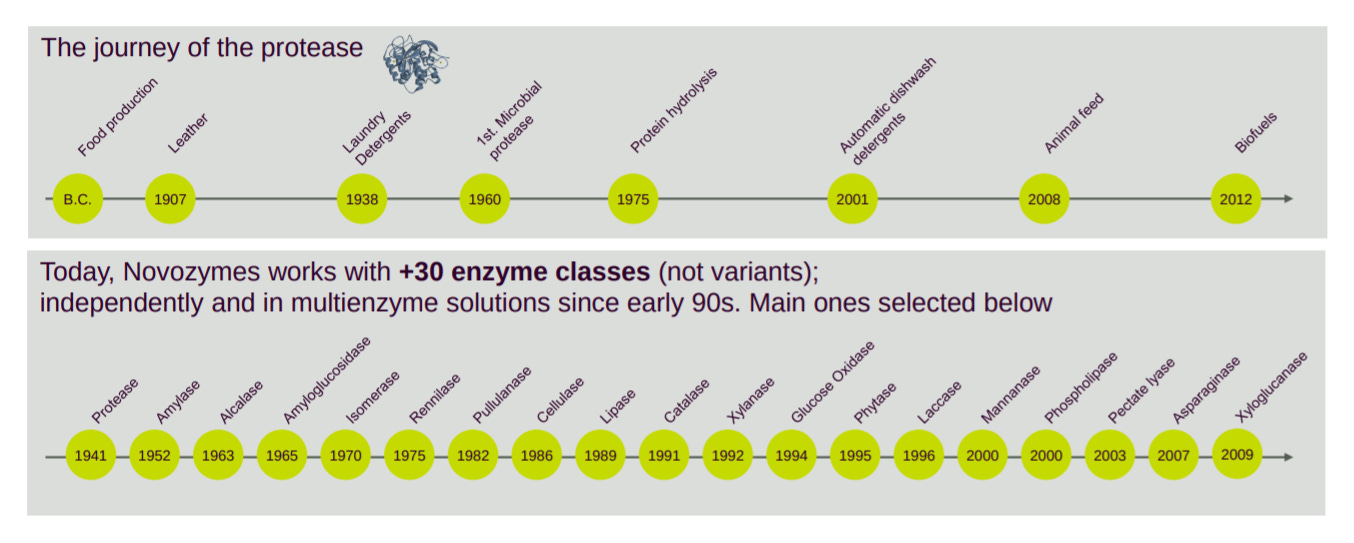
Novozymes first established itself with the introduction of Termozym in 1952, the company’s first enzyme from microbial sources and Aquazym in 1954 to remove starch from fabrics for the textile industry. Then in 1987, the company launched Lipolase, their first enzyme from genetic engineering to use in detergents. Whereas Termozym and Aquazym took years to develop, Lipolase was commercialized in 4 months - Novozymes’ dominance was getting started. From then on, the company has expanded to over 30 enzyme classes relying on metagenomics to discover new enzymes, molecular biology to design the enzymes, and partners to figure out market applications. To keep ahead, the company will have to bring on new capabilities around design and machine learning to maintain their near monopoly.
With over 30K enzyme structures solved and a lot more possibilities, there is a massive opportunity to take on Novozymes and actually expand the market at the same time. Software-enabled life sciences companies and those with scalable screening tools will do well here.
Novozymes is established in household products, food, beverages, grain-based ethanol, and manufactured products. Growth for the company is around biopharma, agriculture, biomass conversion, animal health, and nutrition. Picking the right market will be the make-or-break decision for upstart enzyme companies.
What are some example markets for enzymes?:
Textiles - the oldest application of enzymes in the textile industry is using amylases (catalyze hydrolysis of starch into sugars). Starches are used to prevent fabrics from breaking during weaving. Cellulases are also used for finishing especially for stonewashed jeans. Pectinases are used to degrade pectin, catalases are used to get rid of H2O2 after bleaching, and proteases for wool treatment.
Cleaning dishes - proteases are used to clean dishes with egg yolk/whites (i.e. Ovozyme).
Paper coating - amylases are also used to modify paper improving smoothness and gloss
There are so many different untapped markets and use cases for enzymes spanning industry, consumer products, and drug development - who wants to build the next-generation of enzyme companies? Feel free to email me.
The Porter Trial
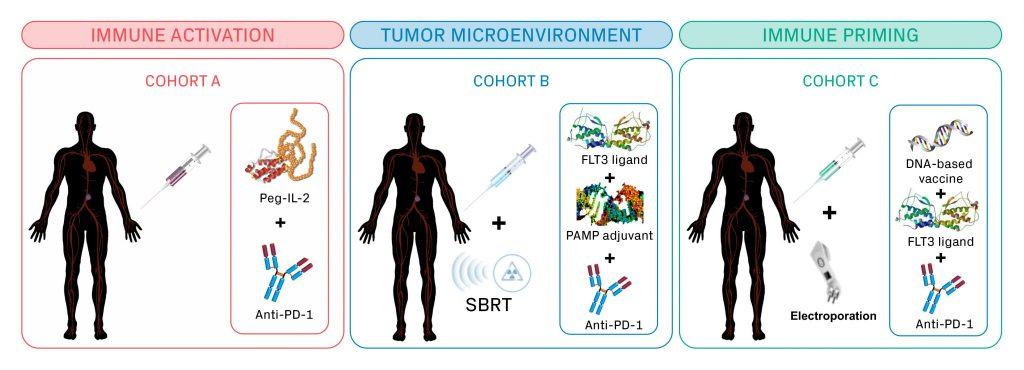
The PORTER Trial is an umbrella trial sponsored by the PICI. PORTER = Platform Study for Prostate Researching Translational Endpoints Correlated to Response to Inform Use of Novel Combinations. Where a basket trial tests one drug in multiple disease types, an umbrella trials test multiple drugs in one disease type. The PORTER trial might be the best ongoing example of the latter. The trial is focused on metastatic castration-resistant prostate cancer:
Cohort A: Peg-IL-2 + Anti-PD-1
Cohort B: Stereotactic body radiation therapy (SBRT) + FLT3 ligand + PAMP adjuvant + Anti-PD-1
Cohort C: FLT3 ligand + DNA-based vaccine with PSA, PSMA and IL-12 plasmids + Electroporation + Anti-PD-1
Basket and umbrella trials are part of a class of trial designs called master protocols, which is a single design to evaluate multiple hypotheses. Master protocols are set up to have one control arm for multiple arms and increase clinical trial efficiency/standardization. Umbrella trials are particularly useful for indiciations with a clear MoA and some sort of biomarker even at low prevalence. Whereas umbrella trials are not useful for indications with a lot of mutational heterogeneity, which increases the number of patients required and the development of multiplex assays for screening. The key goal for the PORTER Trial versus other umbrella trials like NCI-MATCH and Lung-MAP is to increase the success rate of getting a patient with an actionable mutation into a treatment arm. Another consideration for these types of trials is that a patient may have multiple actionable mutations making eligible for multiple treatment arms; this is a bioethics problem
The premise of the PORTER trial came up in ~2017 between PICI and the Cancer Research Institute to hone in on running an umbrella trial in prostate cancer due to the unmet need and the disease’s fit (i.e. biomarkers available) to run this trial of master protocol. The readouts of the study will be exciting, but the design and execution of the trial will likely have a lasting impact on medicine and oncology. Cohort A has been closed for enrollment with B and C still open; what’s exciting is the evolution of the trial to a platform study, another master protocol type, adding new treatment arms over time.
Seven Powers cont.
The sixth of the 7 powers is cornering a resource. In life sciences, this power is focused around:
Patents
Talent
Trade secrets
Regulatory capture
Distribution strongholds
Cornering a resource means a business has preferential access to an asset, ideally at attractive terms. The idea is that having a patent or a monopoly on a certain type of talent helps a company build a compelling product that no one else has. Cornering a resource relies on having a unique method to discover new ideas, people, and inventions. This is the most straightforward power to understand in life sciences - most companies corner resources through patents and trade secrets. Moreover, the price of the resource itself cannot go up to make the company that corners it unprofitable. This is a problem for talent.