
Axial - Observations #31
Life sciences reflections
Build with Axial: https://axial22.axialvc.com/
Axial partners with great founders and inventors. We invest in early-stage life sciences companies such as Appia Bio, Seranova Bio, Delix Therapeutics, Simcha Therapeutics, among others often when they are no more than an idea. We are fanatical about helping the rare inventor who is compelled to build their own enduring business. If you or someone you know has a great idea or company in life sciences, Axial would be excited to get to know you and possibly invest in your vision and company . We are excited to be in business with you - email us at info@axialvc.com
Observations #31
A set of ideas and observations from a week’s worth of work analyzing businesses and technologies.
Building vertical communities in science
Dewpoint Therapeutics is an emerging drug company focusing on condensates. They are working on exciting science and built a great team. However, under the hood, Dewpoint is building a very unique community centered around their field of focus: condensates -
https://condensates.com/
I have never seen a drug company let alone many life sciences companies build this type of product. However, this has the potential to create a new standard required to build a science-driven company. Building a community around a particular vertical has advantages for:
Aggregating talent around a new class of biology or science
Provide resources to this talent - hire them for Dewpoint or do other projects with them
Have more precise distribution to people interested in condensates
Correspondingly, have a channel to share news and other developments on Dewpoint’s side
Dewpoint’s condensates website has an editor publishing recent news and publications on the field as well as jobs and events. Over time, I am sure they will expand to more resources to help the condensate scientific community. If this works and helps Dewpoint build a moat around talent, every science-driven business will need to start doing something similar.
If you’re a company in natural products, create naturalproducts.com. If you’re in CAR-T, do car-t.com. If you’re in cell-free technologies, do cellfree.com. And so on.
Mitochondrial Stress
Mitochondria are the energy-generating organelles in the eukaryotic cell. The organelle has 4 compartments: outer mitochondrial membrane (OMM), the intermembrane space (IMS), the inner mitochondrial membrane (IMM), and the mitochondrial matrix. With ~1500 proteins in a eukaryotic mitochondrion, around 98% of these proteins are encoded by nuclear genes and translocated from the cytoplasm to the mitochondrial matrix.
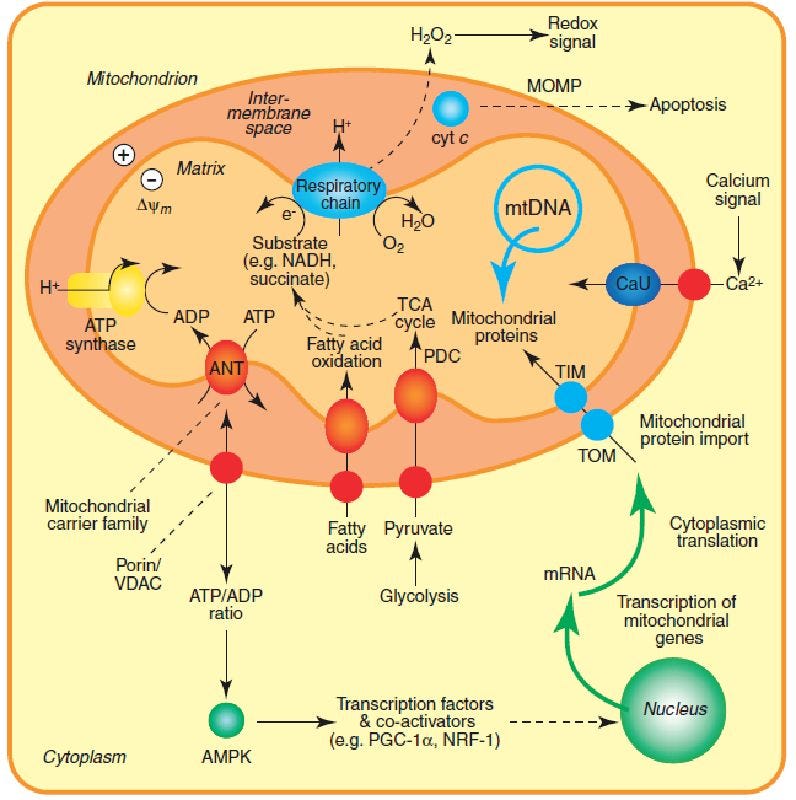
Metabolism is mainly driven by mitochondria. Changes in mitochondrial function due to genetics and external factors (i.e. stress insults like hypoxia) lead to significant changes in metabolism. As a result, dysfunctional mitochondria plays a role in chronic diseases like diabetes as well as cancer, cardiovascular disease, fibrosis, and neurodegeneration. The mechanisms and targets are still being uncovered but the commonality seems to be changes in mitochondrial reactive oxygen species (ROS), ATP, or calcium metabolism. There are three key themes linking mitochondria and disease:
Mitochondrial stress and unfolded protein response (UPR) - external signals can alter the membrane potential of mitochondria inducing the mitochondrial UPR that ultimately feeds back into changing gene expression in the nuclear. This is an open class of biology that over time will create more and more targets for medicine. Stress in the mitochondria causes the higher expression of mitochondrial chaperones and proteases (i.e. UPR). Afterwards, signalling between the mitochondria and nuclear, called mitochondrial retrograde signaling, is the exciting pathway to study.
Quality control in mitochondria - overactive mitochondria can lead to misfolded proteins that lead to the UPR with quality control machinery (i.e. chaperones to help with folding and proteases) to fold or remove damaged mitochondrial proteins
Mitochondria and ER cross-talk - lastly, during the stress response, the mitochondria and endoplasmic reticulum (protein production) form a connection to maintain cellular equilibrium. There is a direct transfer of lipids and calcium ions between the endoplasmic reticulum (ER) and mitochondria. This regulates protein folding and mitochondrial activity.
The first generation of mitochondria-targeting drugs focused on improving metabolism by increasing ATP production. Mitochondria make ATP through oxidative phosphorylation, generating reactive oxygen species as a by-product. These first generation drug candidates failed in trials mainly because of two reasons:
Difficulties for the drugs to cross the double-membrane structure of the membrane; small molecules cannot passively diffuse into the membrane
Not accounting for the physiological function of ROS in the design of a drug or selection of a target
The next-generation of drugs in the field are focused on new genetic targets, compounds that localize to the mitochondria or have a high affinity for mitochondrial membrane proteins/lipids. Designing drugs with ROS in mine is still an open question. Excitedly, the role of mitochondria in disease is being further characterized driving the importance of inventing new tools and methods to solve the 2 major problems in mitochondrial drug development:
Mitochondria in the blood - https://faseb.onlinelibrary.wiley.com/doi/full/10.1096/fj.201901917RR
Mitochondria and cancer - https://www.nature.com/articles/s41467-019-09566-3
Mitochondria and neuroscience - https://3dd62f27-592a-4438-9a2a-f4afdd6f4482.filesusr.com/ugd/faa101_1d92ed0f7e9b4a52950d08c1a41010d7.pdf
Mitochondria and Wnt signalling - https://3dd62f27-592a-4438-9a2a-f4afdd6f4482.filesusr.com/ugd/faa101_ddf2b1b0671f4e15bb295c377abf7125.pdf
Mitochondria and lipid biosynthesis - https://3dd62f27-592a-4438-9a2a-f4afdd6f4482.filesusr.com/ugd/faa101_3f872a696d654f89ad819b05120b0538.pdf
Mitochondria and autoimmunity - https://www.cell.com/cell-metabolism/pdf/S1550-4131(20)30419-8.pdf
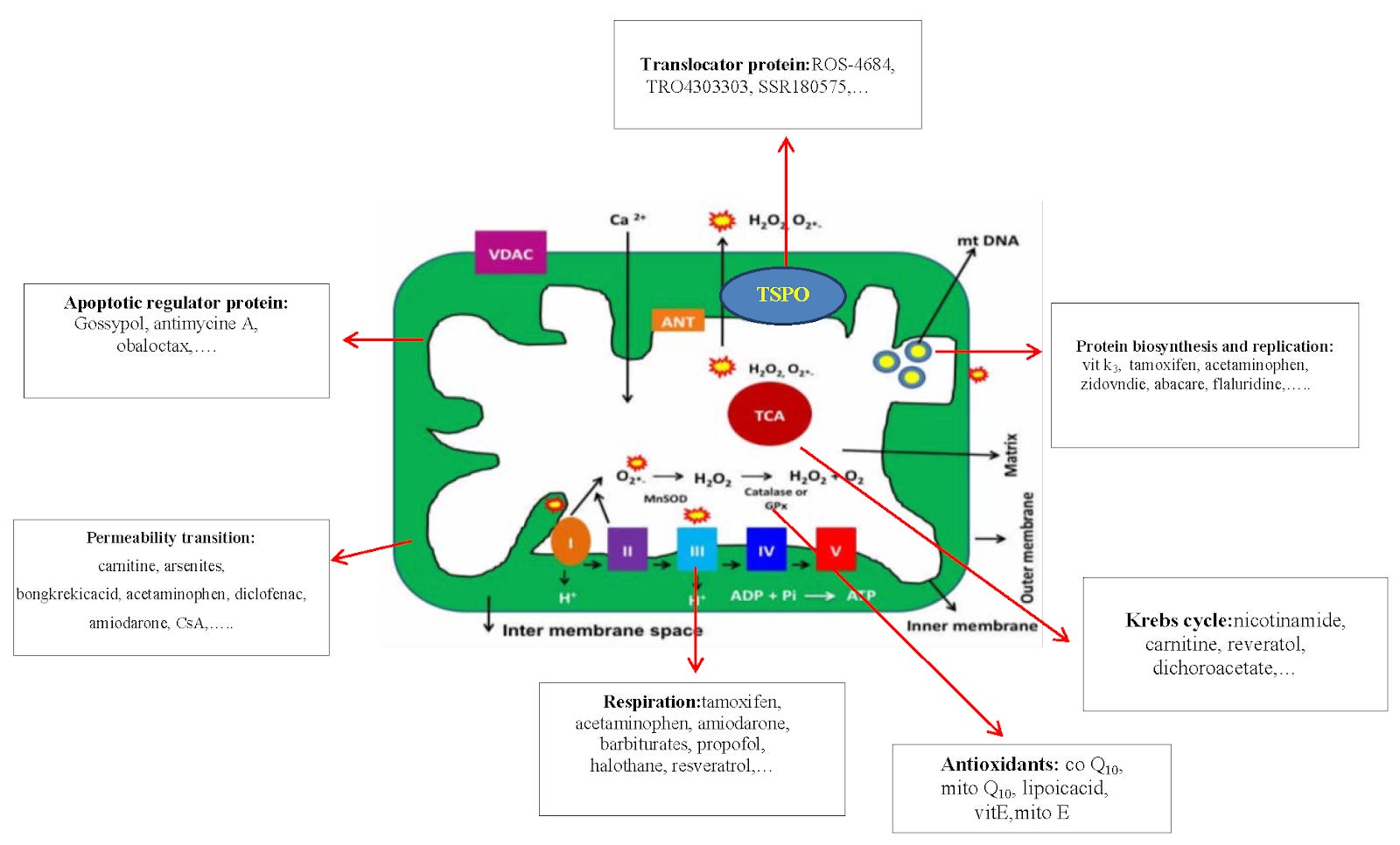
Like most new classes of biology, core discoveries are made in model organisms. For mitochondrial stress, C. elegans is the workhorse. Overtime, new targets and pathways in the models become validated in humans. Overall, how drugs localize to different organelles and even condensates is still being explored. For mitochondrial stress, there a 3 key drivers for disease, 2 major problems for the drug development industry to solve, and a long-list of targets:
How to find hidden gems?
Gregg Popovich, the head coach of the San Antonio Spurs, has built one of the most enduring teams in sports history. The Spurs is a case study of the interplay between a system and superstars. Tim Duncan and David Robinson are basketball superstars. But over the last 2 decades, the Spurs have also made superstars in players like Manu Ginoboli, Tony Parker, and Kawhi Leonard. Early on Popovich was curious about international players and finding talent where others are not looking. Beyond the players and the coach, the Spurs show the power of the backoffice with RC Buford, the CEO of the Spurs, leading most of the talent scouting. Popovich focuses on the connectivity of the team. RC finds the talent -
I grew up a Shaq and Kobe fan. The Spurs were also tough to get by in the Western Conference Finals. What lessons from the Spurs can be transferred to something like life sciences in order to find hidden gems:
Find excellence in areas where others are not looking
Like other countries
Like smaller universities
When building a team, treat superstars as normal people to set the tone for the rest of the team (i.e. Popvich would yell at Tim Duncan even if another teammate made the mistake). But you can only do this if you are a winning team.
Seven Powers cont.
The fourth of the seven powers in business is switching costs, which is the loss a customer will experience from switching over from the product they are using to another one. This power is actually pretty widespread in life sciences. If you think switching enterprise software is hard, switching a biomanufacturing protocol, an EHR in healthcare, or a diagnostics workflow is a lot harder to switch over.
The hard part about getting switching costs as a moat in a business is getting the customers. Either you have to knock off an existing product or pursue a new class of customers first. Once you get switching costs, they imbue pricing power to your business and can give you the power to put your competitors at a price disadvantage if needed.
This power is divided into 3 subclasses:
Financial - the most lost from switching (i.e. switching over to a new plasmid editor and having the bear the costs of the new software, onboarding, and complementary services)
Relationships - losing personal and business relationships as well as brand association from switching over. Great sales people become advisors to their customers on more matters over time.
Procedural - this is the hardest of the subclasses to define and may be the most important for a business; the risk of switching from the familiar to the new, riskier, and uncertain product. Doing something new especially at a large corporation where billions may be on the line is scary. Becoming a familiar product and brand ultimately might create the strongest switching cost.
What are the downsides to switching costs? This might be the most seductive business power and as a result might create fatal weak points in a business:
Shifts in technology can make a product obsolete and your business might not recognize this or want to change until it’s too late
Organizational laziness because the sales people, product people, and beyond kind of know the customers are not likely to use new products
But if a good leader, often a founder, can keep the company ahead of the technology curve and their company focused on the customers, switching costs are often a springboard to aggregate more customers to commoditize more complements. By executing this strategy, the business can find new customers beyond your current sandbox and move into using branding as a business power.