Axial - Observations #22
Life sciences reflections
Build with Axial: https://axial22.axialvc.com/
Axial partners with great founders and inventors. We invest in early-stage life sciences companies such as Appia Bio, Seranova Bio, Delix Therapeutics, Simcha Therapeutics, among others often when they are no more than an idea. We are fanatical about helping the rare inventor who is compelled to build their own enduring business. If you or someone you know has a great idea or company in life sciences, Axial would be excited to get to know you and possibly invest in your vision and company . We are excited to be in business with you - email us at info@axialvc.com
Observations #22
A set of ideas and observations from a week’s worth of work analyzing businesses and technologies.
Full-stack healthcare
Software is enabling entire new business models in healthcare where costs can be more easily controlled through tighter integration of the care “supply chain.” The key themes for full-stack healthcare are:
Vertical integration: doing things like combining primary care and insurance
Commoditizing a part of the supply chain; for healthcare, the supply chain is: providers, payors, patients
Aggregate and expand to new markets: an example is collecting patient data to power drug development
Across the supply chain, companies in each part have different incentives. Payors, insurers in particular, are incentivized to raise the cost of care to collect more premium payments. Whereas, providers have increasing revenue but depending on whether they are primary care or a specialist, margins are very different. Patients have very little say in their healthcare.
A company like Oscar is aggregating patients to gain advantages on the payor side. Crossover Health is doing something similar but focusing on the provide side. New entrants in healthcare are building full-stack models by backward integrating starting from the patient and the care experience. Incumbents like UnitedHealthcare are forward integrating, but that may be a losing position because companies like Oscar acquire patients on experience, not just plan price.
Full-stack drug development
Similarly, full-stack drug development is increasingly possible:
Vertical integration: combining drug development with frontend services
Commoditizing a part of the supply chain; for drug development, the supply chain is: R&D, clinical, manufacturing, marketing
Aggregate and expand to new markets: an example is first selling generics then shifting toward branded medicines
Full-stack healthcare and drug development businesses are solving problems from different starting points but overtime will likely be on a collision course. Companies like Hims and Roman have used generic drugs as an entrypoint for the larger drug market. These set of companies rely on consumer marketing and brands to provide complete solutions for patients to treat things like ED and hair loss but could move into chronic disease and beyond.
What are some of the advantages of a full-stack model in drug development?:
Control pricing across the supply chain. A big part of high drug prices are due to PBMs.
Integrating the patient experience with software can improve drug adherence, clinical trial recruitment, and medical referrals.
Generate real-world data to improve the development of new medicines.
So it seems pretty obvious that traditional drug companies will partner with a company like Hims or just might buy them.
Peptides and small molecules
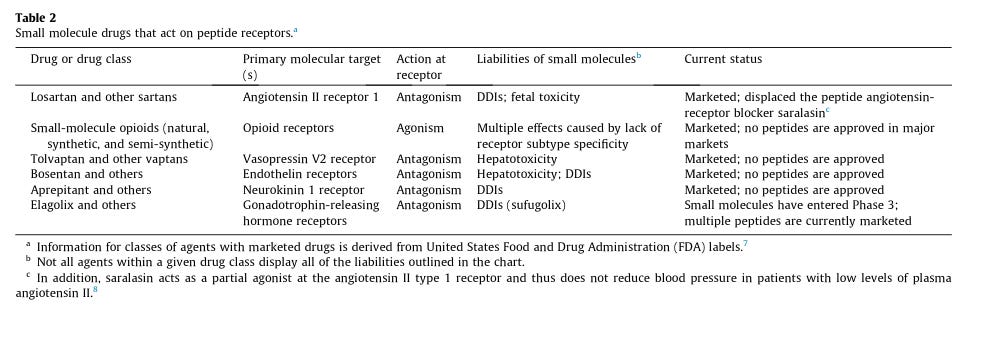
Genomics has led to the discovery of a wide-set of receptors and their corresponding endogenous peptide ligands. These receptors play important roles in oncology, pain, and beyond. However, developing peptide therapeutics to target these receptors have major limitations due to the peptide drugs’ lack of oral bioavailability and low pharmacokinetics (i.e. short half-life, rapid degradation, and high levels of clearance). As a result, a powerful strategy in drug development is identifying peptide receptors and developing a small molecule to mimic the peptide ligand.
Are there companies out there building up a database of a small molecule’s ability to replace a peptide ligand? The targets are pretty easy to identify.
Reversing Parkinson’s disease
A group at UCSD recently did a proof-of-concept study in mice to convert astrocytes (a glial cell) to functional neurons to rescue some symptoms of Parkinson’s disease. Excitedly, the group used antisense oligonucleotides (ASO) to selectively deplete a certain protein to initiate this conversion.
The premise of the paper was centered on an observation that an RNA-binding protein, PTB, has a role in the maturation and induction of neurons. Importantly, during neurogenesis, PTB protein levels are downregulated. As a result, the idea was that inhibiting PTB protein levels might be able to reprogram a glial cell into a neuron. Previously, another paper showed that repressing PTB enabled conversion of fibroblasts into neurons. The key experiments was validating the one-step strategy to convert astrocytes to neurons and showing the neurons repopulate certain regions of the brain in a mouse model of Parkinson’s:
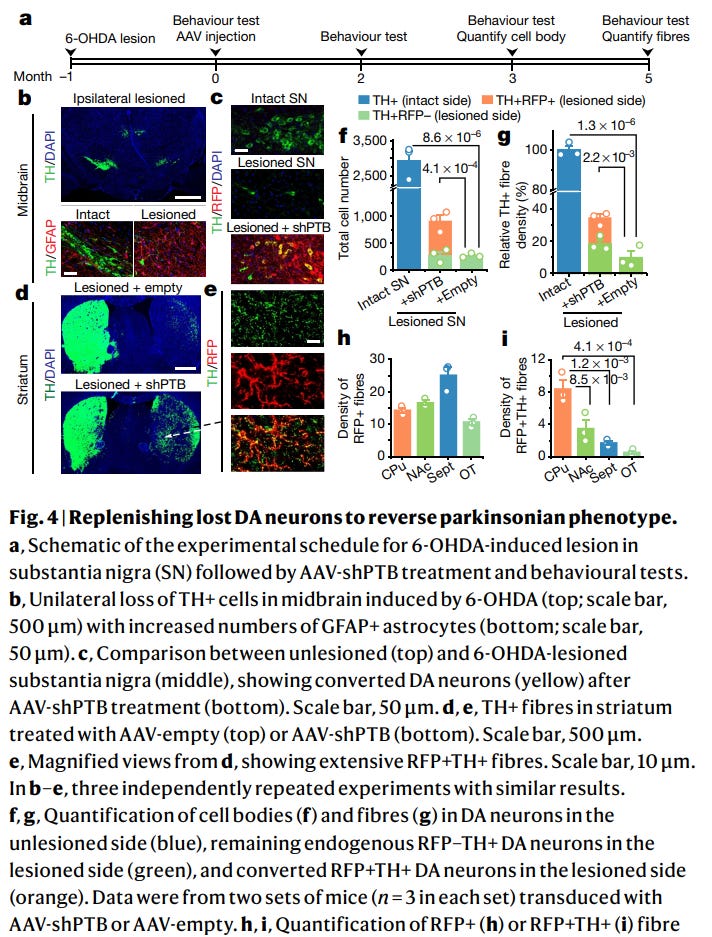
The paper is really a tour-de-force. The group pulled off a series of incredible experiments. From a business perspective, this PoC shows the power of an ASO drug to potentially treat neurodegeneration via reprogramming cells. The next step is to understand how to target specific cell types/brain regions and understand what the age limits are for a therapy like this. The powerful result is that an ASO can lead to a dramatic neuronal conversion. There might not be a need for a cell transplant or something more complex.
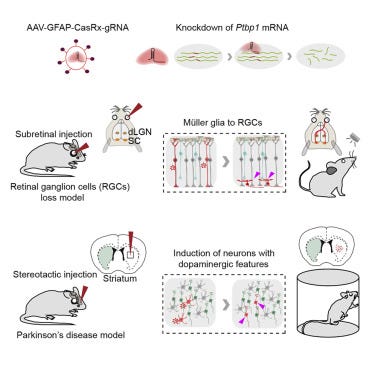
Around the same time, the UCSD paper was published, another group was able to use a CRISPR system to convert glial cells into functional neurons as well focusing on another RNA-protein called Ptbp1: