
Axial - Observations #15
Life sciences reflections
Build with Axial: https://axial22.axialvc.com/
Axial partners with great founders and inventors. We invest in early-stage life sciences companies such as Appia Bio, Seranova Bio, Delix Therapeutics, Simcha Therapeutics, among others often when they are no more than an idea. We are fanatical about helping the rare inventor who is compelled to build their own enduring business. If you or someone you know has a great idea or company in life sciences, Axial would be excited to get to know you and possibly invest in your vision and company . We are excited to be in business with you - email us at info@axialvc.com
Observations #15
A set of ideas and observations from a week’s worth of work analyzing businesses and technologies.
SPACs and new ways of going public in life sciences
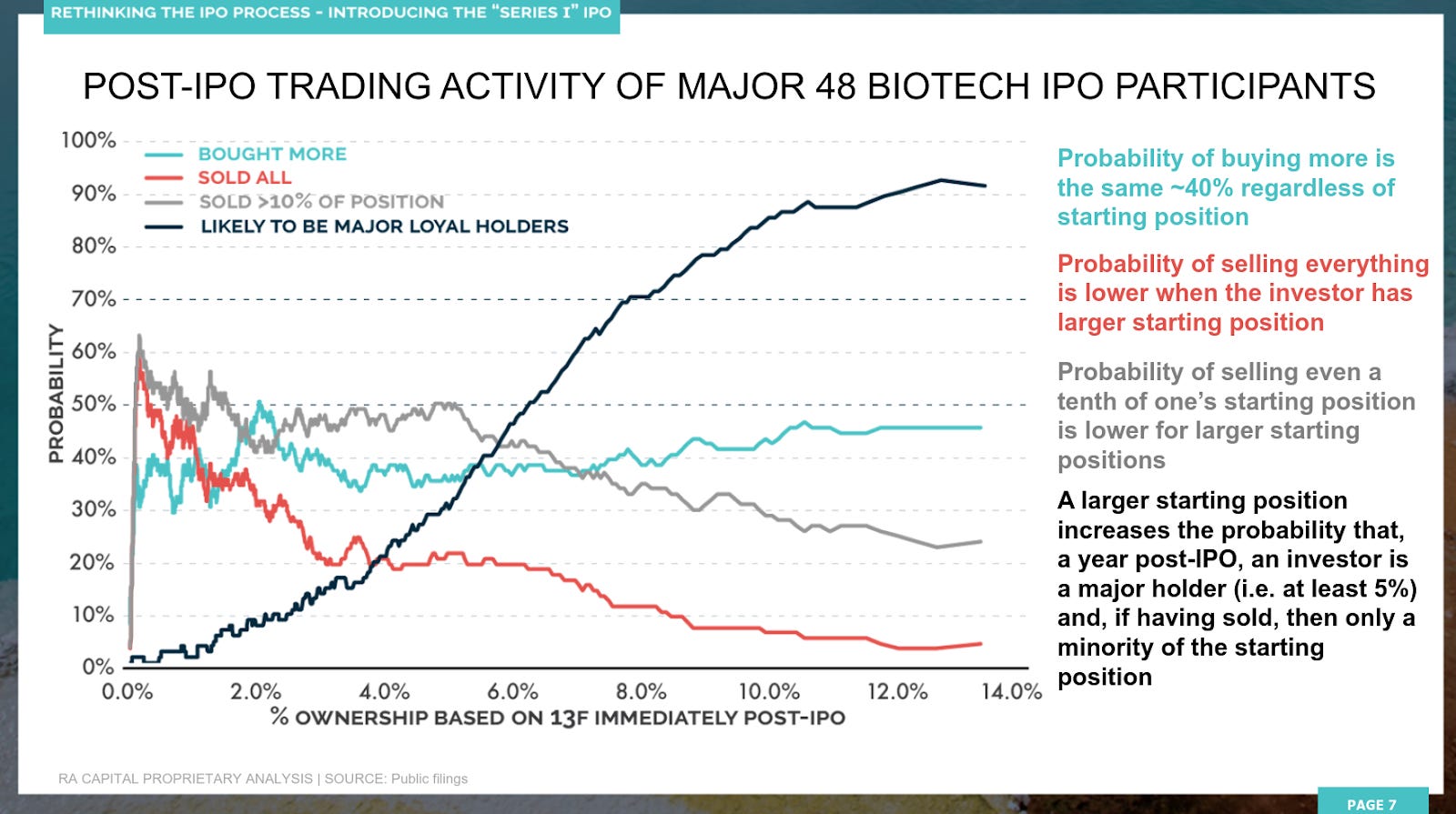
Forma Therapeutics (FMTX) just went public this Friday using a different pathway designed by RA Capital called Series I. In short, insiders buy up most of the offering with $2M open to outsiders. Essentially, the process gives up liquidity for price control - one could call it, a public insider round. Investors can get a markup with “liquidity” and companies get access to public markets for financing rounds down the line.
In combination with this, biotech hedge funds have been raising special purpose acquisition companies (SPAC) to take companies public instead of using a standard IPO process. RA Capital, Perceptive, RTW Investments, EcoR1, Deerfield, and a few others have raised SPACs of their own. SPACs issue public shares to raise a pool of capital to buy a company. SPACs are pretty controversial tools - they are blank check companies that can be misused so the chairman/CEO of each SPAC has to be well-trusted.
Moreover, biotech companies have historically used battered stocks to use them as vehicles to go public via a reverse merger. The use of SPACs and Series I are additions to the arsenal of biotech companies. The ability to get liquidity is a major advantage for investment firms and companies. A traditional IPO is not always required.
Primary care - the next generation
Primary care is the first point of contact for a patient. But building a new business centered around it has been incredibly hard due to reimbursement: specialists get paid a lot more than a good primary care physician. Interestingly, some of the largest insurance companies like Kaiser and Humana started off with a clinic/primary care business. Owning the patient relationship enabled plans to be offered down the road.
Beyond the patient relationship, primary care is the point where care is triaged and patients are routed to particular services within a healthcare network. But, insurance companies neither have the will or ability to influence what happens to a patient at this point - for the former, they make more money if care costs go up and for the latter, many insurance companies don’t have physicians on their staff.
The shift from coding to fee-for-value and risk delegation is making primary care business models more attractive:
https://www.healthcaretownhall.com/?p=9535#sthash.BqOKwWch.dpbs
For example, a patient with a kidney disorder coming in to visit their primary care physician could be sent to an ER, specialist, back home, and so on. Especially for chronic diseases, the primary care point has a high amount of leverage to reduce costs. The kidney patient could be sent to a high-cost surgery but may only need a prescription to solve their problems. Changing the overall incentives to solve patient problems rather than maximizing codes is going to lead to a massive shift in primary care business models.
Smart Toilets and Smart Pipe
I spent a summer at Beckman Coulter - I lived down the street from headquarters. On a side note, Arnold Beckman is an incredible case study of an inventor who built an enduring business. Almost every lab has a Beckman centrifuge. While spending a summer at Beckman, I would spend my lunches walking around the manufacturing facilities and coming up with diagnostics ideas. One was focused on a smart toilet. We emit at least a 100 kg of feces per year: that is a treasure trove of molecular information to track one’s health.
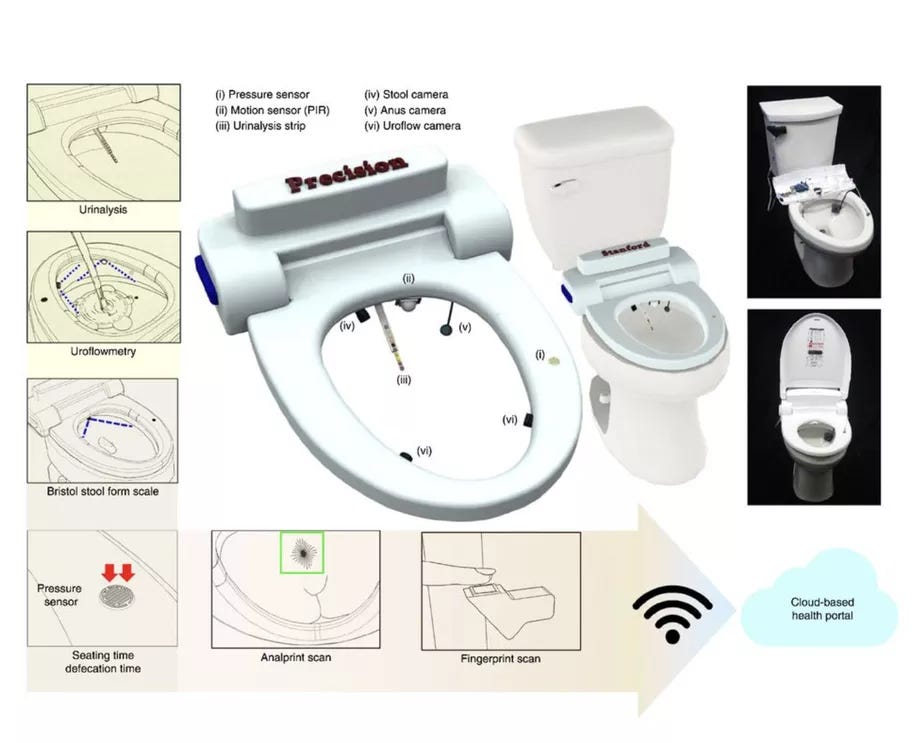
The Gambhir Lab at Stanford recently built a prototype of a smart toilet to create a unique fingerprint for each person and monitor health:
In short, the modular device is equipped with cameras and Raspberry Pi sensors to monitor feces and detect urine streams. It measures things like the flow rate and stream time for excretion and can ever monitor white blood cell counts and some proteins. A lot of work still needs to be done to figure out what diseases could be detected and how to get people to install a device like this on their toilets, but the potential impact on public health of a smart toilet is unbounded in some ways.
Every time I revisit the idea of a smart toilet, this bit on the smart pipe comes up -
The business of public health
Public health, things like vaccinations, trash pickup, sewage, and more, has a large impact on economic growth, lifespan, and wellbeing. These paragraphs from OECD research - https://oecdobserver.org/news/archivestory.php/aid/1241/Health_and_the_economy:_A_vital_relationship_.html - sums this impact up well:
“The effects of health on development are clear. Countries with weak health and education conditions find it harder to achieve sustained growth. Indeed, economic evidence confirms that a 10% improvement in life expectancy at birth is associated with a rise in economic growth of some 0.3-0.4 percentage points a year.
Disease hinders institutional performance too. Lower life expectancy discourages adult training and damages productivity. Similarly, the emergence of deadly communicable diseases has become an obstacle for the development of sectors like the tourism industry, on which so many countries rely.”
Public health initiatives in the 20th Century enabled the US and the West in general to grow substantially. However, public health problems still exist in countries like the US especially around defensive measures and in less developed countries. Creating a great business and products in public health has been a problem: how does an entrepreneur create a sustainable way to eradicate malaria? What companies can be built to deploy rapid infectious disease diagnostics? What spots are just intractable and the realm of nonprofits?
Some of the most important problems to work on are:
Neglected Tropical Diseases (NTD)
Communicable diseases like tuberculosis, HIV, and malaria
Antimicrobial resistance
Pandemic preparation
Child mortality and maternal/reproductive health
Nutrition
Access to clean water