Axial - Observations #14
Life sciences reflections
Build with Axial: https://axial22.axialvc.com/
Axial partners with great founders and inventors. We invest in early-stage life sciences companies such as Appia Bio, Seranova Bio, Delix Therapeutics, Simcha Therapeutics, among others often when they are no more than an idea. We are fanatical about helping the rare inventor who is compelled to build their own enduring business. If you or someone you know has a great idea or company in life sciences, Axial would be excited to get to know you and possibly invest in your vision and company . We are excited to be in business with you - email us at info@axialvc.com
Observations #14
A set of ideas and observations from a week’s worth of work analyzing businesses and technologies.
Biohacking
This is a really fascinating example of using simple biohacking tools to individually measure one’s health and lose weight - https://karpathy.github.io/2020/06/11/biohacking-lite/
Biohacking is the right to modify oneself and environment without hurting others. There are a string of posts of people taking their health in their own hand - this post is actually a less extreme version. What this post describes is what Virta Health does in some way. The potential for companies to allow individuals to actually modify their body is a huge opportunity, with a diverse set of customers, starting at simple ways to track energy expenditure and weight loss to editing one’s own genes.
From the author’s post a profound way to look at the body’s energy system is as a series of batteries of growing strength:
super short term battery. This would be the Phosphocreatine system that buffers phosphate groups attached to creatine so ADP can be very quickly and locally recycled to ATP, barely worth mentioning for our purposes since its capacity is so minute. A large number of athletes take Creatine supplements to increase this buffer.
short term battery. Glycogen, a branching polysaccharide of glucose found in your liver and skeletal muscle. The liver can store about 120 grams and the skeletal muscle about 400 grams. About 4 grams of glucose also circulates in your blood. Your body derives approximately ~4 kcal/g from full oxidation of glucose (adding up glycolysis and oxidative phosphorylation), so if you do the math your glycogen battery stores about 2,000 kcal. This also happens to be roughly the base metabolic rate of an average adult, i.e. the energy just to “keep the lights on” for 24 hours. Now, glycogen is not an amazing energy storage medium - not only is it not very energy dense in grams/kcal, but it is also a sponge that binds too much water with it (~3g of water per 1g of glycogen), which finally brings us to:
long term battery. Adipose tissue (fat) is by far your primary super high density super high capacity battery pack. For example, as of June 2019, ~40lb of my 200lb weight was fat. Since fat is significantly more energy dense than carbohydrates (9 kcal/g instead of just 4 kcal/g), my fat was storing 40lb = 18kg = 18,000g x 9kcal/g = 162,000 kcal. This is a staggering amount of energy. If energy was the sole constraint, my body could run on this alone for 162,000/2,000 = 81 days. Since 1 stick of dynamite is about 1MJ of energy (239 kcal), we’re talking 678 sticks of dynamite. Or since a 100KWh Tesla battery pack stores 360MJ, if it came with a hand-crank I could in principle charge it almost twice! Hah.
lean body mass :(. When sufficiently fasted and forced to, your body’s biochemistry will resort to burning lean body mass (primarily muscle) for fuel to power your body. This is your body’s “last resort” battery.
Machine learning and DELs
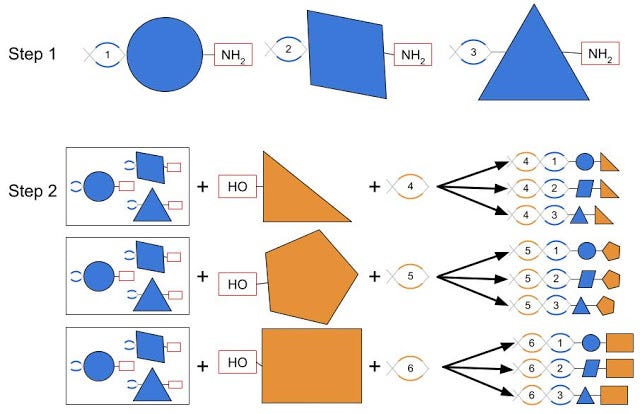
DNA-encoded libraries (DEL) are efficient ways to screen large amounts, up to billions of small molecules, of chemical matter against a given target. The next generation of DEL companies will have to use machine learning to take advantage of the scale and diversity of the tool to identify valuable hits. For most scaffolds, there are ~10^60 drug-like possibilities -
https://www.nature.com/articles/s41586-018-0056-8. DELs represent the most scalable way to screen small molecules and contain a little over 10^9 entities. That’s a 50 order of magnitude spread. This is the core problem machine learning solves for DELs: provide the ability to explore the structure-activity relationships (SAR) within a given screen and select for certain features. This is really important because screening exhaustively across an entire chemical space is way too hard so building out the toolkit to get good at picking hits from large DEL datasets is likely going to lead to promising medicines.
What are the key levers for DEL companies using machine learning:
On-target binding
Biodistribution of the small molecules
ADMET - absorption, distribution, metabolism, excretion, and toxicity
Synthesis routes / medchem work required
What are other key things machine learning can enable for DELs or small molecule screening in general? Maybe connecting a small molecule and biological effects with potential blocking IP, clinical success odds, market potential?
Healthcare business models
What are the key healthcare business models?:
Owning patient flow - Virta Health (probably has the highest potential to disintermediate payors)
Clinical trials - Flatiron Health and Komodo Health; but the payors are often biopharma so I’m not sure this falls within healthcare
New workflows within existing healthcare infrastructure - PatientPing and Teladoc
EHR/data infrastructure - Cerner and Epic
It seems that creating a new healthcare company built within existing structures is pretty foolish. Epic and Cerner create this massive barrier to entry with their Oracle-like behaviors and payors are hesitant to adopt new technologies. Patients and clinicians suffer. It appears the best option for founders is to build products that cure and manage disease where they own the patient relationship. Once that patient network is formed, a company like Virta essentially could jump into insurance.
The composition of insurance plans
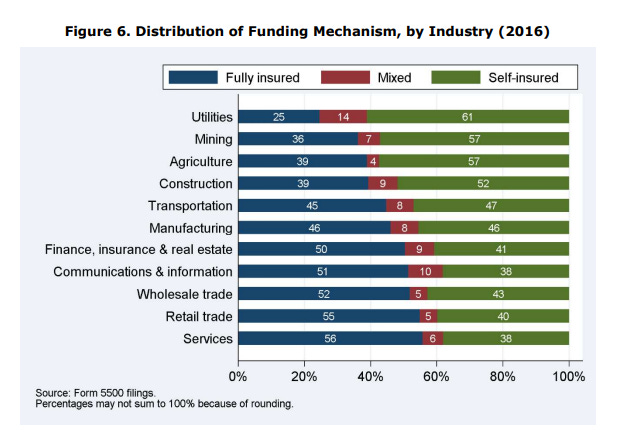
On this part of patient-focused companies having the potential to become payors, understanding the underlying composition of insurance plans seems interesting. Beyond just large companies like Anthem, what is the distribution of plan sizes in the US and so. Looking under the hood at plans could portend on what types of insurance will get disintermediated first. First, the three types of health insurance in the US are:
Private - 150M people
Public - 130M people
Self-insured - 14M people
Looking at data from 75M (mainly employee-based) plans (study: https://www.dol.gov/sites/dolgov/files/EBSA/researchers/statistics/retirement-bulletins/annual-report-on-self-insured-group-health-plans-2019-appendix-b.pdf), over half the population of insurance plans are 5K and over. This phenomenon is worse for public plans. These plans and the individuals are a massive opportunity for healthcare companies. Rather than focusing on the allure of the large markets of healthcare software, there is a larger opportunity to own the patient relationship.
The odds of a successful medicine
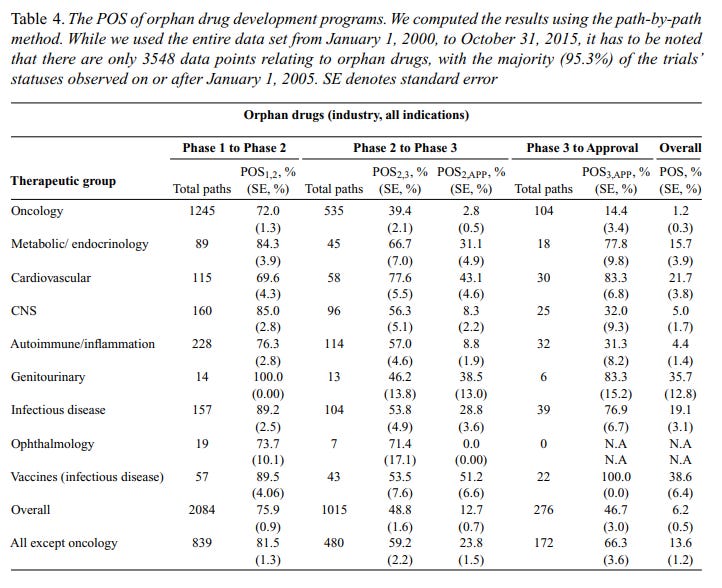
These are some pretty interesting tables on the probabilities of success for a drug across indications and stages. It’s bizarre that orphan drugs have such a steep drop from phase 1 to 2.